

Shrines TotK: how shrine design shapes Tears of the Kingdom’s open world
Shrines are the most consistent micro-dungeon format in modern Nintendo design, and in Tears of the Kingdom they carry an unusual share of the open-world workload. Combat, traversal, and large dungeons all lean on shrine spaces either as practice arenas, as reward nodes, or as quiet moments of mechanical experimentation. For a player, the practical question is not whether shrines are in the game, but how the system is structured: how many exist, how they gate progression, what they reward, and how their placement changes exploration. For a designer or producer, the deeper question is why the format is repeated so often and what the design trade-offs of that repetition look like.
This page focuses on the game-development and design angle of shrines in Tears of the Kingdom, with a player-facing layer of useful detail underneath. It treats shrines as a designed system rather than a checklist, explains the mechanics that govern them, and connects their structure to broader questions about open-world pacing, content density, and player-led progression. The goal is to give developers a frame for reading the system, and to give players a more useful vocabulary for the choices they make inside it.
What counts as a shrine in Tears of the Kingdom
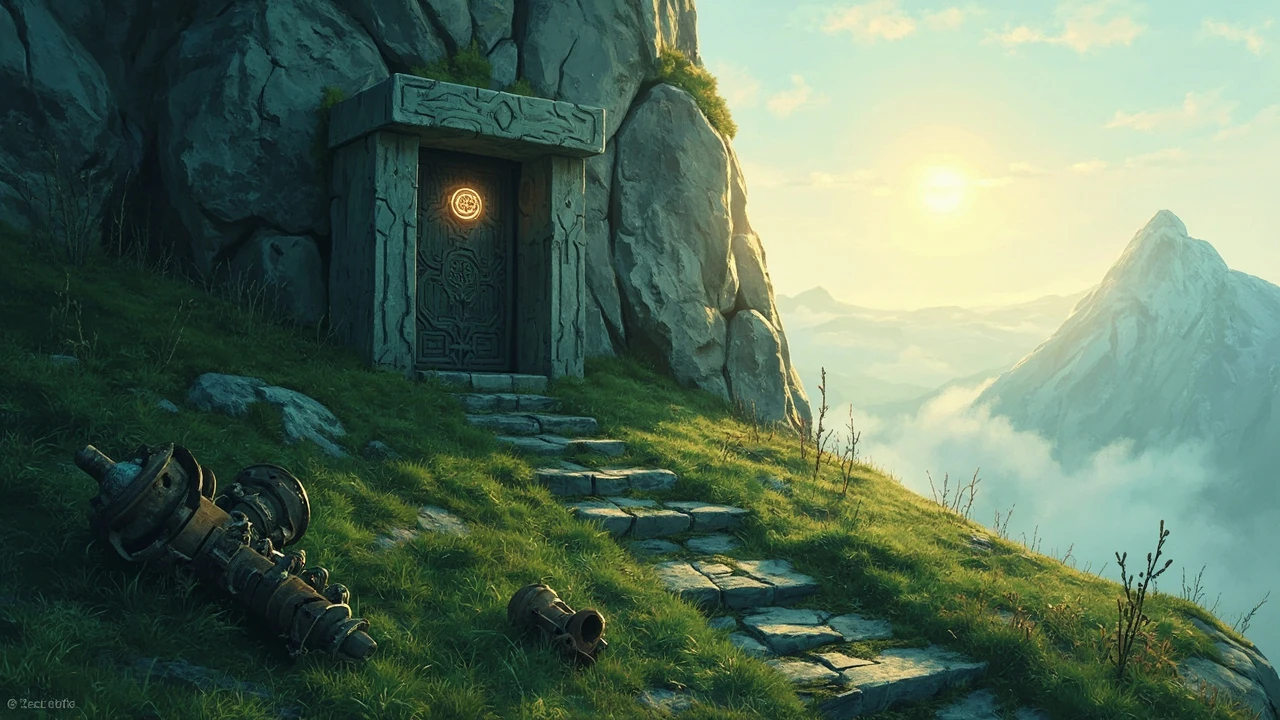
A shrine in Tears of the Kingdom is a small, self-contained test chamber marked by a glowing circular symbol on a stone door. The format is shared with Breath of the Wild, but Tears of the Kingdom extends it in three ways: the addition of shrines that begin as a puzzle on the surface and finish inside, the use of shrines as activators for the Lightroot network in the Depths, and a wider range of environmental themes tied to sky islands and underground regions.
Shrines behave differently from the larger Divine Beasts-style dungeons and from the regional phenomena. Divine Beasts-style structures are still the main story dungeons, but the design team has offloaded a significant amount of mechanical teaching and reward distribution to shrines. This split is intentional: shrines are short, forgiving, and replayable in spirit, while story dungeons carry narrative weight and longer commitment. The split also lets shrines appear in clusters of three or four in a single biome without competing with the regional arc.
Inside a shrine, the structure tends to follow a small template. A short entry path leads to a single primary puzzle room, with one or two side branches for hidden chests. The puzzle room tests one or two abilities, often with a single environmental twist such as a moving platform, a water level, or a set of fans. The reward is delivered at a goddess statue inside or just outside the shrine, which keeps the loop self-contained.
How many shrines exist and what they hold
Shrine counts in Tears of the Kingdom are a frequent source of confusion because of the way surface shrines and Lightroot shrines are paired. The design works as a mirror: each surface shrine has a counterpart in the Depths, so a player who maps both is effectively collecting two related pieces of content per location. Treating each pair as one logical shrine is a useful mental model, even when the count on a player’s map looks different.
| Shrine type | Where it appears | Primary purpose | Reward structure |
|---|---|---|---|
| Standard combat or puzzle shrine | Surface and sky islands | Tests a single mechanic or combat skill in isolation | One or two chests, a Light of Blessing on completion |
| Proving grounds shrine | Surface | Multi-wave combat encounter with limited resources | Chest plus completion reward |
| Sky shrine | Sky Islands and launched into the air | Combines traversal with isolated puzzle | Chest plus completion reward, often tied to regional story |
| Depths shrine (via Lightroot) | Underground Depths | Acts as a fast-travel anchor and visual landmark when activated | No separate puzzle; unlocks the Depths map and fast travel at the Lightroot |
The exact total of unique shrines can shift as the game is patched, so this article does not give a hard number that could age into a correction. What is stable is the structural pattern: each surface shrine is paired with a Lightroot in the Depths, the same completion logic applies, and a Light of Blessing is the standardized reward for finishing a shrine that contains a real puzzle. That stability is the point. The system is designed to be readable across patches.
Shrine rewards and the Light of Blessing economy
The reward system inside shrines is one of the cleaner examples of game-economy design in the open-world genre. Each completed shrine grants a Light of Blessing, which converts into a heart container or a stamina gauge increase at a goddess statue. Side chests inside shrines carry gear, rupees, arrows, or zonaite, depending on the shrine’s theme. The economy is simple on purpose: one currency, one upgrade path, and a wide distribution of sources.
For designers, the key mechanic is that shrine completion is decoupled from story progression. A player can finish almost any shrine without affecting main-quest triggers. This decoupling is what allows Tears of the Kingdom to scatter shrines across every biome without forcing a specific order, and it is also what makes the system forgiving for players who want to experiment with Ultrahand or Fuse in low-stakes spaces before trying them in story content. It is also what allows post-game players to revisit shrines as practice rooms.
- Each completed shrine provides a Light of Blessing that can be exchanged at any goddess statue for a heart or stamina upgrade.
- Hidden chests inside shrines usually contain consumable resources, elemental arrows, or a piece of equipment that benefits the same mechanic the shrine tests.
- Some shrines are designed around a single key idea, such as rotating a platform, attaching fans, or using Ascend in a tight vertical space.
- Shrine completion feeds both the surface map and the Depths map, which is why the Lightroot pairing matters for fast travel.
- Side rewards such as zonaite or crystallized charges scale with the player’s current ability set, so a returning player still gets useful material from earlier shrines.
Surface shrines, sky shrines, and underground counterparts
Surface shrines are the most familiar type. They sit at the end of a visible path, often signaled by the glowing ring on the door, and they blend into the surrounding biome. Sky shrines begin on the surface as a target object that has to be launched into the air or reached through a sky island, and they usually end with a paragliding return. Underground shrines do not exist as playable puzzles in the same way; instead, activating a Lightroot on the surface completes a paired shrine and opens the Depths map in that region.
| Environment | How the shrine is found | Skill it tends to test | Common failure mode |
|---|---|---|---|
| Surface plains and ridges | Following a glowing ring on the door or a quest marker | Basic Ultrahand or Fuse logic | Overbuilding a solution and running out of zonai charges |
| Sky island cluster | Launching a device upward or riding a thermal | Trajectory planning and battery management | Misjudging battery and falling before reaching the chest |
| Depths via Lightroot | Finding the dark mirror of a known surface shrine | Map literacy and pathfinding in low light | Getting turned around before reaching the light |
| Cold or hot biome | Following environmental cues near water or lava | Resource and elixir planning | Entering unprepared and running out of cold or heat resistance |
The split between surface, sky, and Depths shrines is a design decision that affects pacing. Sky shrines tend to be more linear because their entry point is unusual, surface shrines are flexible and forgiving, and Depths counterparts are mostly navigational rather than mechanical. The result is that a player’s shrine experience shifts texture as they move between altitudes, even though the reward and completion logic stays consistent. That texture shift is what keeps the format from feeling like a single repeated task.
How shrines connect to the rest of the open world
Shrines in Tears of the Kingdom do not exist in isolation. They are nodes in a wider open-world network that includes towers, wells, caves, korok puzzles, and the regional stories tied to each stable or town. The design intent is that shrines act as mechanical set-pieces within a larger exploration loop, not as standalone minigames. The placement of a shrine usually signals the type of content around it: a shrine near a stable often has a stable quest associated with it, a shrine inside a labyrinth tends to test orientation, and a shrine in a cold region usually rewards elixir or warming gear.
For a producer or level designer, this placement pattern is one of the more interesting choices in the system. A shrine acts as both a destination and a teaching node. Players who find a shrine through pure exploration are rewarded with a self-contained puzzle that uses local resources, while players who chase shrines from the map see a predictable mechanical curriculum spread across the world. Both audiences are served without splitting the content into separate tracks.
The network effect is also visible in traversal. A shrine on a ridge often sits near a stable, a tower, and a korok cluster, which means a player who climbs toward a glowing ring is also setting up fast travel, map completion, and side content in the same route. That overlap is what makes the world feel like a single connected space rather than a set of disconnected arenas.
Why the design team reused the shrine format
The decision to keep the shrine format from Breath of the Wild is a deliberate continuity choice with measurable benefits. From a production perspective, reusing the format allows the team to ship a large number of varied, hand-tuned puzzles without scaling the full dungeon team. From a player perspective, familiarity lowers the on-ramp: a returning player already knows what a shrine is, how its door opens, and what completion feels like.
The design trade-off is that repetition can feel mechanical if every shrine reads the same way. Tears of the Kingdom addresses that risk in three ways: the introduction of sky shrines with vertical entry, the mirror structure of surface shrines and Lightroots, and the use of shrines as testing grounds for new Ultrahand, Fuse, and Ascend combinations. The system is recognizable, but the new abilities keep individual puzzles fresh.
- Reuse lowers player friction and on-ramp time for returning players.
- Standardized rewards simplify economy balancing and let designers place shrines anywhere without breaking progression.
- Abilities like Ultrahand and Ascend turn the format into a tool for player creativity instead of a fixed pattern.
- Mirror placement of Lightroots turns shrine exploration into a multi-layered mapping system rather than a flat checklist.
Player progression through shrine content
From a player view, the practical path through shrines looks like this: discover a shrine by sight or by following a quest, enter and complete its core puzzle, look for hidden chests, exit, claim a Light of Blessing at the nearest goddess statue, and repeat. That loop is short enough to be picked up in five minutes, which is part of why the format scales well across a 60 to 100 hour playthrough.
The pacing implications are more interesting than the loop itself. A player who treats shrines as their primary activity will see the world through a different lens than one who treats them as side content. The first player builds a strong mechanical vocabulary early, the second keeps the world feeling more open and slower. The design supports both without favoring either, which is a textbook example of player-led pacing in an open-world title.
There is also a soft progression curve inside the shrine set itself. Early shrines test single abilities in clean rooms, mid-game shrines combine two abilities with environmental hazards, and late-game shrines assume the player can switch between Ultrahand, Ascend, and Fuse under time pressure. That internal curve mirrors the player’s growth without changing the reward structure, which keeps the upgrade economy predictable. For broader context on the series that this system belongs to, the Legend of Zelda entry offers a useful summary.
Shrines as testing grounds for abilities
One of the most useful ways to think about shrines is as a controlled environment for player abilities. Tears of the Kingdom introduces a wide set of build tools, and shrines function as a curriculum for them. A shrine that asks the player to attach a fan to a raft is not just a puzzle; it is a teaching moment for the Ultrahand system as a whole.
- Ultrahand shrines teach attachment logic, vehicle construction, and the limits of zonai energy.
- Ascend shrines teach vertical movement and ceiling detection, often in tight enclosed spaces.
- Fuse shrines teach material combination, including weapon durability and arrow effects.
- Combat shrines isolate timing, dodge behavior, and weapon matchups without mob clutter.
For a developer reading this, the model is worth noting: instead of front-loading tutorials in a closed prologue, the design team distributed teaching across the world using a familiar container. The container looks the same in every biome, but the lesson inside is contextual. That choice has a cost: tutorial pop-ups are minimal, so players who skip shrines also skip the lessons. The design assumes the player will engage with the format, and rewards that engagement with cleaner skill growth.
It is also worth noting that the teaching is layered rather than linear. A player can revisit an early shrine with later abilities and solve it differently, which reinforces the idea that the abilities themselves are the curriculum, not the shrine order. That is a quiet but important choice, and it is what makes the system feel like a toolbox rather than a track.
Shrine puzzles and player creativity
Shrines are designed with one or two intended solutions, but Ultrahand-based shrines in particular can be solved in many ways. This is a deliberate design choice, and it has a real cost. Designers have to validate that shrines still work when a player solves them with an unexpected build, which can include stacking, glue abuse, or physics exploits.
That cost is worth it for two reasons. First, the variety of solutions keeps replay value high for players who return to shrines after mastering the abilities. Second, the visible complexity of player solutions feeds the social ecosystem around the game, which is part of why shrine footage circulates so widely. The shrine format is, in effect, a publishing-friendly container for emergent gameplay.
There is also a design lesson in the failure modes. When a shrine can be broken by an unexpected build, the failure usually comes from a physics or attachment edge case rather than from the puzzle logic itself. That suggests the design team treated the puzzle logic as the contract and the build system as the wild card, which is a reasonable split given how much of the game is sold on the build system.
Quality assurance and shrine testing
For a QA perspective, shrines are a useful case study in controlled testing. Each shrine is a small, self-contained scene, which makes it easier to isolate bugs related to attachment, fuse behavior, or pathing. It is also easier to regression-test after patches because the entry conditions and reward triggers are stable.
| QA concern | How shrines help | How shrines complicate testing |
|---|---|---|
| Reproducibility | Shrines are self-contained, so bugs can be reproduced without setting up a wider scene | Player creativity can produce non-reproducible edge cases |
| Regression coverage | Reward triggers and chest unlocks are consistent | Ability changes can invalidate older shrine solutions |
| Performance | Smaller scene size keeps memory and draw calls predictable | Player-built vehicles can stress physics budgets in unexpected ways |
| Localization | Text and symbols are short, which reduces localization churn | Some shrines depend on visual cues that need cultural review |
One consequence of this QA profile is that shrine patches tend to be quiet. A fix to an attachment bug or a fuse interaction can be shipped without touching the rest of the world, which lowers the risk of regression. It also means that reported shrine bugs are often solved in narrow updates rather than bundled into larger patches, which is useful information for any team running a long live cycle.
Shrines and map density
Map density is one of the most underappreciated consequences of the shrine system. By placing shrines at regular intervals, the design team ensures that the player is never far from a known reward and a fast-travel point. This is a major reason the world feels generous without feeling empty. A player can look at the horizon, pick a glowing ring or a Lightroot, and walk toward it without needing to open the map.
For open-world designers, this is a useful pattern. The shrine is a low-friction way to add content density and to support player-driven route planning at the same time. The cost is the risk of saturation, which is why the team also varies entry methods and adds sky and underground variants. The pattern is portable: any open-world team with a fast-travel system can borrow the idea of a recurring, recognizable container that doubles as a map node.
It is also worth noting that map density from shrines has a knock-on effect on the rest of the world. Towers, stables, and towns tend to cluster around shrine locations, which means the density of one system shapes the density of everything around it. That kind of layering is what makes the world feel interconnected rather than scattered.
Shrines versus dungeons in player experience
Shrines and the larger story dungeons in Tears of the Kingdom serve different emotional roles. Shrines are quick, satisfying, and mechanical. Dungeons are longer, narrative-driven, and require commitment. The mix is part of why the game can hold attention for long sessions without becoming exhausting.
- Shrines deliver micro-rewards and a sense of mechanical mastery.
- Dungeons deliver story beats, set-piece design, and longer combat arcs.
- Surface exploration connects both, using shrines as breadcrumb content and dungeons as milestones.
- The pacing between shrine and dungeon activity is player-driven, not scripted, which fits the open-world philosophy.
For developers, the contrast is a useful reminder that not all open-world content needs to be large. A well-tuned short container can carry a surprising amount of progression, and it can keep the player in flow between longer arcs. The trick is to make the short container feel like part of the world, not a side mode, which is exactly what the shrine format achieves.
What shrine design teaches other open-world games
Shrines in Tears of the Kingdom are a useful blueprint for open-world teams thinking about content density without linear mission gating. Three lessons stand out.
First, a familiar container lowers the cost of teaching. Players do not need a new orientation for every puzzle, which means more of their attention can go to the specific mechanic being tested. Second, decoupled rewards let designers place content anywhere in the world without breaking progression. Third, mirror placement between surface and underground creates a feeling of reward for both halves of an exploration session without doubling the workload for handcrafted interiors.
These are not exclusive to this game, but the combination is unusually clean. The system is also a useful counter-example to the idea that open-world games need dozens of distinct mission types. A single well-tuned container can carry the weight of an entire game’s mechanical curriculum if the abilities inside it are deep enough. That last point is the one most worth borrowing: depth in the ability set matters more than variety in the container set, and a small number of containers can scale surprisingly far when the abilities are rich.
Limits of the shrine system
No design is free of trade-offs, and the shrine system has visible limits. A player who is not interested in puzzles will feel the repetition after a few dozen shrines, and the format does not work well for narrative beats that require long scenes. The team mitigates this by reserving story content for dungeons and regional events, but the cost is that shrines are best understood as mechanical content rather than story content.
From a production perspective, the system also concentrates a lot of QA and tuning work in one container. A change to Ultrahand or Fuse can ripple across hundreds of shrines, which raises the cost of ability design. That cost is offset by the consistency it creates, but it is worth naming for any team thinking about copying the pattern. The system is also biased toward players who enjoy systems thinking: players who want a stronger story hook will need to engage with the regional arcs and dungeons instead.
It is also worth noting that the mirror structure, while elegant, can feel like doubling the workload to a player who only wants one half of the experience. A player who dislikes the Depths is still rewarded for activating Lightroots, which can read as friction rather than as a design choice. That is a real limitation, and it is part of why the system works best for players who are willing to engage with both halves of the world.
How to think about shrines before you start
For a player about to engage with the system, a useful approach is to treat shrines as a training ground rather than a task list. The first ten shrines are the best place to learn the limits of Ultrahand, Ascend, and Fuse, because failure inside a shrine only costs a moment of respawn. After that, shrines become a way to explore efficiently and to expand heart and stamina on a player’s own schedule.
For a developer, the takeaway is the opposite. The best way to read the system is as a curriculum embedded in the world. If you map which abilities each shrine tests, you get a clear picture of how the design team wanted players to internalize the toolset. That map is more useful than the shrine count for understanding the game’s design intent. It is also a useful template for any team thinking about how to teach a complex ability set without a long prologue.
Frequently asked questions
How many shrines are there in Tears of the Kingdom?
Shrine counts have been adjusted by updates over time, so this article does not give a hard number that could age into a correction. What is stable is the structural pattern: each surface shrine has a Lightroot counterpart in the Depths, and a Light of Blessing is the standard reward for completing a real puzzle. Treating each pair as one logical shrine is a useful mental model, even when the count on a player’s map looks different.
Do shrines in TotK give the same rewards?
Most shrines give a Light of Blessing on completion and may also contain one or two hidden chests. The chests carry consumables, arrows, rupees, or a piece of gear that fits the shrine’s theme. The exact contents vary, but the completion reward and the upgrade structure at a goddess statue are consistent across the game.
What is the difference between a shrine and a dungeon in TotK?
Shrines are short, self-contained puzzle or combat chambers, usually completed in a few minutes. The larger story dungeons are longer, more narrative-driven, and involve a fuller arc with a boss at the end. Both use the same visual language, but their role in pacing is different.
Do I need to complete shrines to progress the main story?
Main story progression does not depend on completing shrines. Shrines are designed as optional content that supports exploration, mechanical learning, and player-driven character growth. You can ignore them entirely and still follow the critical path, though you will miss upgrades and ability practice.
What are Lightroots and how do they relate to shrines?
Lightroots are the underground mirrors of surface shrines. Activating a Lightroot lights up a section of the Depths map and unlocks fast travel for that area, similar to how surface shrines act as map nodes. The pairing is one of the design choices that makes the system feel cohesive across altitudes.
Are sky shrines different from regular shrines?
Sky shrines begin as an object or a launch point on the surface and finish in the air, usually on a sky island. They test the same abilities as surface shrines, with more emphasis on trajectory, battery management, and paraglider use. Their reward structure is the same.
Can shrines break or become unbeatable in TotK?
Shrines are designed with multiple valid approaches for most Ultrahand puzzles, which reduces the chance of an unbeatable state. If a player gets stuck, leaving the shrine and re-entering resets objects and physics. Save corruption that blocks shrine progress is rare, but the in-game reload from the main menu or a shrine exit usually clears any unusual state.
Why do shrines matter for open-world design?
Shrines in Tears of the Kingdom are a clean example of how a single container can carry the weight of an open-world mechanical curriculum. They lower the cost of teaching, decouple rewards from story, and let designers place content at any altitude without breaking pacing. For developers, the system is a useful reference for content density without mission gating.
Do shrines scale with player progression?
Shrines themselves do not scale in difficulty, but the player’s ability to solve them improves as the toolset grows. Early shrines are useful for learning the basics, while later shrines assume the player is comfortable with Ultrahand, Ascend, and Fuse. This creates a soft difficulty curve without changing the underlying reward structure.
What should a new player do first in shrines?
A new player is best served by treating the first ten shrines as practice. Failure inside a shrine is cheap, and the lessons learned there apply directly to story content and combat. After the basics are in place, shrines become a flexible way to grow heart and stamina at the player’s own pace.
Leave a Reply