

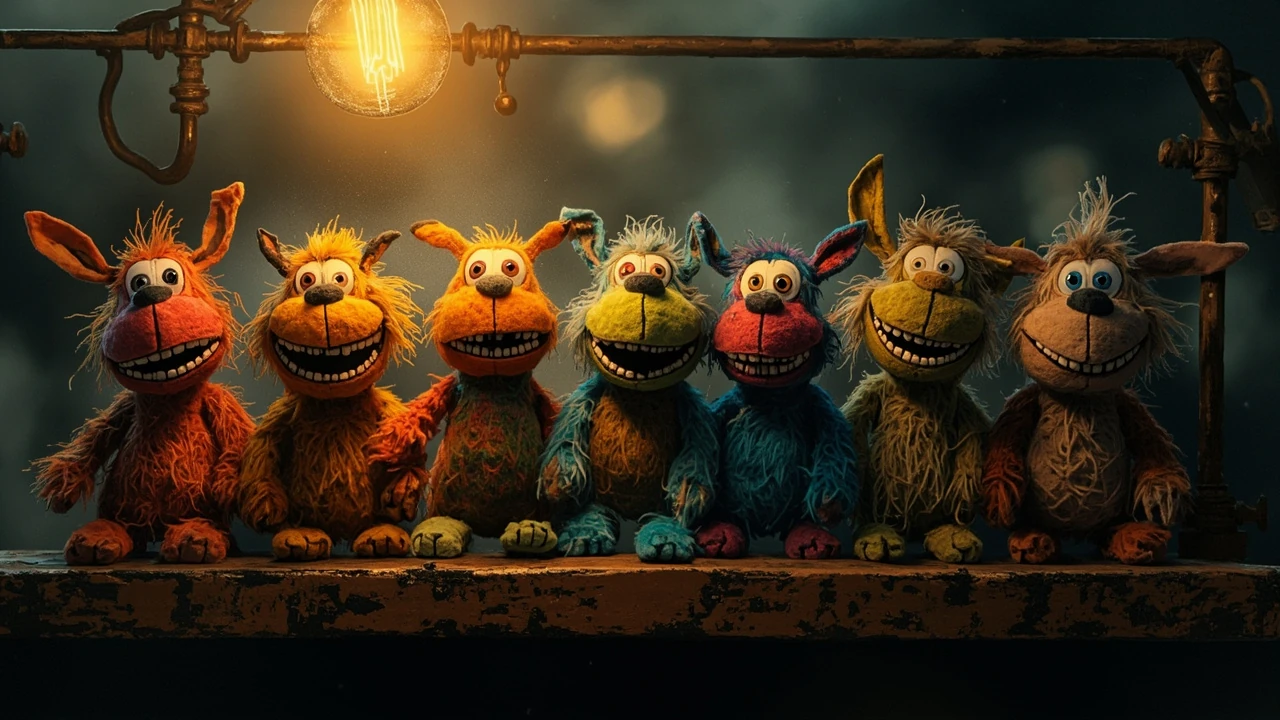
Smiling critters as a design problem in Poppy Playtime
Inside Poppy Playtime, the smiling critters are not decorative mascots. They sit at the center of a tension that the series uses for its jump scares and its worldbuilding: a toy line built to be sold to children that has been wired into a much darker corporate program. Reading the cast as design assets, rather than as cartoon cameos, explains why players feel unsettled the moment a plush stares at them down a hallway. The smiles are products. The bodies are not.
For a developer or designer studying the franchise, the smiling critters line is useful because it is one of the few horror ensembles that has to do several jobs at once. Each critter has to read as a distinct character on a toy shelf, contribute to a remembered cartoon, and survive as a credible threat once the story makes them organic. The same outline that carries a plush’s marketing personality has to be re-used in scripted deaths, environmental storytelling, and first-person encounters. The critters are therefore a compact case study in character design, lore pacing, and gameplay readability, all under one brand.
this page focuses on how the smiling critters function inside the game rather than retelling the broader Poppy Playtime timeline. It draws on the confirmed cast from Chapter 3, the cartoon that opens the chapter, and the surrounding lore, then looks at what each element means for character briefs, encounter design, and player psychology. The aim is to give a working designer or producer a clear read on why the cast works, where the design still depends on player imagination, and what the limitations are when the in-game evidence runs out.
Where the smiling critters sit inside Poppy Playtime
Playtime Co., the fictional toy maker that frames the Poppy Playtime series, builds the smiling critters as a major consumer brand in the late 1980s. The cast is meant to be marketable, with a full cartoon and a personality for each character, so that the company can sell toys while tying those toys into the care of children at Playcare. That dual purpose is the structural reason the smiling critters exist as both story and threat.
The franchise positions the critters as the public face of a deeper project. According to the Poppy Playtime wiki’s breakdown of Chapter 3, the smiling critters were an attempt at a major new product line for Playtime Co., pitched both as something to sell to consumers and as a way of managing the company’s secret test subjects. Through the Bigger Bodies Initiative, the same plush designs are brought to life as organic toys, with the same faces and personalities repurposed as larger, mobile bodies. The story is then free to collapse that gap between marketing image and living creature, and to use the collapse as a source of dread.
By the time the player reaches the Playcare section in Chapter 3, only two of the smiling critters remain. DogDay and CatNap are the survivors, and the rest of the cast has been picked off. That choice is important for design. It means the cartoon at the start of the chapter can show the full lineup as a marketing pitch, and the gameplay can then narrow the field of threats to a small number of named characters. The critter that a player already met as a smiling plush can reappear as a body in a corridor, with the same silhouette and color palette doing the work of recognition.
The full smiling critters cast and what each member signals
Chapter 3’s cartoon introduces the smiling critters as a coordinated set, not as a loose collection. The lineup has eight named characters, each tied to a recognizable personality so that the marketing line can be pitched as a complete gang. The Poppy Playtime wiki’s cast list names KickinChicken, PickyPiggy, CraftyCorn, HoppyHopskotch, Bubba Bubbaphant, Bobby BearHug, CatNap, and DogDay as the public-facing group, with DogDay framed as the leader and CatNap positioned as the moody outlier. Each name is built to read instantly: a verb plus an animal for some, a first name plus an animal for others, and a clear visual hook for the toy line.
For a designer, the cast is easier to read if you split the lineup into functional roles. DogDay is the group leader, the public face who has to carry optimism in the cartoon and authority in the lore. CatNap is the threat inside the group, the character whose powers of sedation make the rest of the cast vulnerable. The remaining six are personality types: cool, food-obsessed, art-focused, energetic, brainy, and caring. Those six give the marketing line enough variety to fill a toy shelf and a cartoon episode, while leaving the narrative work to the two survivors.
| Critter | Public role | Design hook | Status by Chapter 3 |
|---|---|---|---|
| DogDay | Group leader | Plucky dog, optimistic tone | Surviving |
| CatNap | Moody outsider | Cat with red smoke, puts cast to sleep | Surviving |
| KickinChicken | The cool one | Action-focused chicken | Picked off before play |
| PickyPiggy | The food-obsessed one | Pig built around eating | Picked off before play |
| CraftyCorn | The arty one | Corn-themed creative character | Picked off before play |
| HoppyHopskotch | The bouncy one | High-energy hopper design | Picked off before play |
| Bubba Bubbaphant | The brainy one | Elephant tied to intelligence | Picked off before play |
| Bobby BearHug | The caring one | Bear positioned as nurturing | Picked off before play |
The pattern is consistent. Six critters are written as personality types so that the toy line can cover different children, two critters carry the story consequences. This is the same structure many licensed toy lines use, but the game turns it into a body count. The characters a player would happily buy are the characters the narrative removes first.
Why the smiles are the design problem
The smiling critters are a horror design problem before they are a lore problem. The plush toys have wide grins and bright colors that the franchise uses to signal safety. When those same features appear on the organic versions of the characters, the same visual language that built trust becomes the trigger for unease. The smile stops being a friendly expression and starts being a fixed mask that no longer reacts to context.
That tension is built directly into the toy branding. The critters are described on the cast page as colorful animal plushes with wide grins and zany personalities, and the marketing pitch leans on that look. In the cartoon, the wide grin is read as charm. In the abandoned factory, the same wide grin reads as a frozen face. The franchise does not need to redesign the characters to make them scary. It only needs to change the lighting, the context, and the reaction of the character to the player. The smile, which is the design’s main selling point, is the design’s main horror asset.
For a developer, the lesson is that a single feature can carry two opposite readings if the rest of the design supports the shift. Here, the cartoon, the toy line, and the voice acting sell the friend read; the body language, the eye design, and the sound cues sell the threat read. None of those systems need to invent new content. They only need to flip the read of the same asset.
How the cartoon opener sets up the player’s expectations
Chapter 3 opens with a cartoon that functions as a compact design brief for the smiling critters. The episode is a marketing pitch: bright colors, easy dialogue, a clear group leader, and a defined set of personality types. The player sees the cast in a safe context before the game drops them into Playcare and removes most of the cast. The contrast is deliberate. The cartoon shows what the critters were sold as, and the gameplay shows what the toys became.
That opening does the work of a tutorial without ever acting like one. A new player learns the cast, the leader, the threat inside the group, and the visual style of the brand in the time it takes to watch the cartoon. The cartoon also sets the brand voice that the rest of the chapter can either confirm or betray. When the game moves into Playcare and the brand voice is no longer in charge, the player has enough context to read the shift.
The cartoon is also the only place in Chapter 3 where the full cast appears together. From that point on, the player meets the surviving critters in isolation and meets the lost ones through environmental storytelling. The design is built so that the cast introduction is a single concentrated moment, not a slow drip. That is efficient for a horror chapter that has to move on to chase sequences, puzzle rooms, and scripted deaths, and it keeps the brand promise visible long enough for the later scenes to break it.
From plush to body: the Bigger Bodies Initiative in design terms
The Bigger Bodies Initiative is the in-fiction process that turns the smiling critters from plush toys into living toys. The cast page describes the program as the route through which all of the critters are brought to life as organic toys, with the same names, the same faces, and the same personalities, but with bodies that can move through the factory. For the game’s design, the initiative is the bridge that lets the same character live in two formats at once.
In practical terms, the initiative means the art team can reuse the silhouette, the color palette, and the branding of each critter across a plush asset, a cartoon render, and a larger body that can patrol the level. That is a strong production decision. The same character can appear in the cartoon, on a poster in the background, on a toy on a shelf, and as a creature in a chase sequence without needing a redesign. The player recognizes the critter from the cartoon, the merch, and the corpse, all on the same silhouette.
The flip side is that the larger bodies have to carry the same personality traits the cartoon set up. A plush DogDay has to read as a leader, and the surviving DogDay in Playcare has to behave as a leader under threat. A plush CatNap has to read as moody and slightly off, and the surviving CatNap has to read as the most dangerous member of the group. The Bigger Bodies Initiative is therefore a continuity test as well as a visual one. If the organic version breaks the cartoon’s read, the entire cast loses its anchor.
How the cast shapes level design and pacing
Once the smiling critters are reduced to two survivors, the level design in Playcare can lean on that small set without confusion. The player learns quickly that CatNap is the threat, and that DogDay is the more sympathetic figure. Each new room can then play with the player’s read of those two. A room full of CatNap iconography primes a chase, a room with DogDay posters suggests a puzzle, and a quiet corridor with both can be left ambiguous until the sound design gives the answer.
The pacing of Chapter 3 follows the same rule. The cartoon is the cast introduction, the early Playcare sections are the slow reveal of the abandoned line, the middle of the chapter concentrates the player around the two survivors, and the finale concentrates on CatNap as the active threat. The For additional context, lost critters are handled as absences, not as set pieces. Their toys appear on shelves, their faces appear on damaged posters, and their stories are told through environment rather than direct encounter. That keeps the cast list in the player’s head without forcing the level design to model every body.
For a designer, this is a useful template. A horror cast does not have to be fully present in the level to feel present. The smiling critters show that a small group of living characters can carry the weight of a much larger group, as long as the off-screen cast is anchored by clear branding, by environmental storytelling, and by a small number of meaningful interactions.
Reading the smiling critters through player psychology
Players read the smiling critters through the gap between presentation and behavior. A plush that smiles at a child is supposed to be safe. An organic toy with the same smile, the same eyes, and the same branding is not. The player’s fear is built from the question of whether the brand promise is still in effect, and the game answers that question slowly. The cartoon says yes. The factory says no.
That gap is reinforced by a simple production trick: the smiling critters never break character. They do not drop the smile to growl, they do not change expression in a readable human way, and they do not give the player a familiar emotional signal. The wide grin is fixed. The player has to read threat from body language, from sound, and from the behavior of other characters. The smile becomes a mask, and a mask is harder to trust than a face that reacts.
The cast also uses color cues that are familiar from children’s media but that the franchise loads with the opposite meaning. Bright primary colors, soft shapes, and toy-grade textures are all signals of safety in the real world. The smiling critters use the same signals and then put them in dark corridors, on broken shelves, and in chase sequences where the player is the prey. The contrast does the horror work, not the design of the creature. A critter’s smile is only as scary as the room it stands in.
What a character brief for a smiling critter would have to include
If a studio were to write a new critter for a similar horror brand, the character brief would have to cover at least the following ground. The brief has to start with a clear consumer read, because the smile is a marketing promise before it is a horror asset. The brief then has to cover how that read collapses once the body is alive. The collapse is the source of dread, and it has to be designed in from the start, not added later.
- A one-line consumer read, written as if it were a pitch for a toy line aimed at children.
- A visual hook that survives both the plush and the organic version without redesign.
- A personality type that the cartoon can establish in under a minute of screen time.
- A body language set that keeps the personality readable in low light and at distance.
- A sound palette that distinguishes the critter from the rest of the cast and that supports the threat read in the factory.
- A clear role inside the group, so the marketing line reads as a full set rather than as a collection.
- A scripted fate that fits the brand read and that does not need a long cutscene to land.
The smiling critters hit all of these marks with a small number of assets, and that is why the cast works as a study. Each critter is a single silhouette with a single read in the cartoon and a single role in the lore. The production cost per character is low, but the narrative weight per character is high because the brand is consistent.
Where the design has to lean on the player’s imagination
The smiling critters line is careful about what it shows and what it leaves to the player. The cartoon only runs for a short time at the start of Chapter 3, the rest of the cast is rarely shown on screen after the brand introduction, and the lore for each lost critter is told through environment, posters, and implied death rather than through full cutscenes. The franchise trusts the player to fill in the missing detail.
That trust is a deliberate production choice. Modeling, animating, and voicing a full cast of organic toys is expensive, and most of that work would not pay off in gameplay. The franchise needs the cast to feel large and cohesive, but it only needs a small number of critters to act as direct threats. The rest of the lineup is handled by branding, by implication, and by the player’s own memory of the cartoon. The imagination is doing the work that a fully modeled cast would otherwise do.
The limit of that approach is consistency. Once a player starts looking for the lost critters in the level, they have to find enough evidence to feel rewarded and not so much that the game’s pacing breaks. The smiling critters manage that balance by keeping the evidence short, repeated, and tied to the brand. A poster, a toy on a shelf, and a line of dialogue are usually enough to confirm a critter’s fate without adding a new scene. Designers studying the cast should note that this is a budget decision as well as a creative one.
How the smiling critters compare with other horror toy ensembles
The smiling critters are not the first horror cast built around toys, but they handle the toy ensemble in a particular way. Some horror casts use toys as a single recurring threat, with one or two designs that the game reuses across a chapter. Other casts use toys as background dressing, with the real threat being a different creature. The smiling critters sit in between. They are a real cast with a brand, a cartoon, and named characters, but only a small number of them act as direct threats in the level.
| Approach | Cast size on screen | Brand depth | Direct threat count | Player read of danger |
|---|---|---|---|---|
| Single repeated toy threat | One or two | Low to medium | One or two | High, narrow |
| Toy background, different threat | Many as decor | Low | One main creature | Medium, single read |
| Smiling critters in Poppy Playtime | Eight named | High, with cartoon | Two survivors | Wide, with named anchors |
| Animated cast as full enemy roster | Many | High | Most of the cast | High, but expensive to produce |
The smiling critters approach is a compromise that pays off in production efficiency. The cast reads as large because of the brand, but the level design only has to support two direct threats. The rest of the cast is anchored by the cartoon, by the toy line, and by environmental storytelling. For a studio working on a similar horror brand, this is a useful middle ground between a single enemy and a fully animated cast.
Production notes for studios studying the smiling critters
Studios that want to take something practical from the smiling critters should focus on the production decisions, not just the lore. The cast is built so that the same asset can carry a marketing read, a cartoon read, and a horror read without a redesign. That is the strongest piece of reuse in the design, and it is worth copying.
- Reuse the same silhouette across plush, cartoon, and in-game body so the brand stays recognizable.
- Keep the public role short. A one-line read per critter is easier to animate and easier to remember than a multi-page backstory.
- Anchor each critter to a single visual hook, so the player can identify them in low light and at distance.
- Use the cartoon to introduce the full cast in a controlled scene, then narrow the active cast for the rest of the chapter.
- Let the brand do the heavy lifting for off-screen characters. Posters, toys, and voice lines can replace fully modeled encounters.
- Design the smile as a fixed feature, so the threat comes from behavior and context rather than from facial expression.
These are the same rules the smiling critters follow in Chapter 3. They keep the cast manageable in production terms, while still giving the player a sense that the line was once a large, real product inside the world of the game.
Limits of the smiling critters as a design reference
The smiling critters are a useful reference, but they are not a complete template. The cast is supported by a strong cartoon introduction, by a clear brand voice, and by a chapter that has been planned around the surviving two critters. A studio that copies the cast without the same setup will end up with a set of plush designs and no payoff. The cartoon does as much work as the level design.
There are also gaps in what the game shows. The full personalities of the lost critters are not explored in depth, the in-game voices for the lost members are limited, and the body language for the larger versions of the lost critters is not on screen. A studio studying the cast has to be careful not to read more design intent into the franchise than the chapter actually carries. The smiling critters are a marketing line first, and the design choices follow from that constraint.
Finally, the cast depends on the player’s prior knowledge of toys, of children’s media, and of the wider Poppy Playtime lore. A player who has never seen a toy commercial will still feel the dread, but a player who has will read the smiles as a betrayal. The cast works because it sits on top of a shared visual language. Studios building a similar horror brand need to know whether their target audience shares that language before they commit to a cast of smiling toys.
What players actually need to know about the smiling critters
For players who have not yet reached Chapter 3, the most useful summary is short. The smiling critters are a fictional toy line from Poppy Playtime, pitched by Playtime Co. as a major consumer brand and a way of managing the company’s secret test subjects. The cast has eight named members, with DogDay as the leader and CatNap as the threat inside the group. By the time the player reaches Playcare, only DogDay and CatNap are still alive. The rest of the cast has already been removed by the time the chapter begins.
For players who want a sense of the cast before they play, the cartoon at the start of Chapter 3 is the cleanest introduction. It runs long enough to show the full lineup, the brand voice, and the tension between the marketing read and the world read. Players who want to know more about the lost critters should treat the rest of the chapter as environmental storytelling, with toys, posters, and dialogue doing the work of backstory.
For designers and producers who want to take something practical from the smiling critters, the chapter is a study in how a small set of living characters can carry the weight of a much larger cast. The brand does the heavy lifting for the off-screen characters, the cartoon anchors the on-screen characters, and the level design focuses on the two survivors. That is the structure the franchise uses to make a wide toy line feel like a real part of the world, without spending the production budget on a full roster of organic toys.
Frequently asked questions
What are the smiling critters in Poppy Playtime?
The smiling critters are a fictional toy line from Poppy Playtime, built by Playtime Co. in the late 1980s. The cast is a set of colorful plush characters with wide grins and clear personalities, pitched as a major consumer brand and as a way of tying toys into the company’s care of children. The same character designs are then used as organic toys in the factory, which is where the horror of the brand starts.
Who is in the smiling critters cast?
The named cast has eight characters: DogDay, CatNap, KickinChicken, PickyPiggy, CraftyCorn, HoppyHopskotch, Bubba Bubbaphant, and Bobby BearHug. The public lineup is the group that the cartoon at the start of Chapter 3 introduces, with DogDay as the leader and CatNap as the moody outlier who puts the rest of the cast to sleep.
Why are the smiling critters scary?
The smiling critters are scary because their design sells safety while the world around them sells danger. The wide grin, the bright colors, and the toy-grade textures are signals of trust, and the franchise uses the same signals in dark rooms, in chase sequences, and on broken shelves. The smile is fixed, the body language is off, and the player has to read threat from behavior and context rather than from facial expression.
Are the smiling critters real toys in the game?
Inside the fiction of the game, the smiling critters exist in three forms at once. They are sold as plush toys to the public, they appear as characters in the cartoon that opens Chapter 3, and they are brought to life as organic toys through the Bigger Bodies Initiative. The factory the player explores is a mix of the three: toys on shelves, posters on walls, and living bodies in the corridors.
Which smiling critters are still alive in Chapter 3?
By the time the player reaches Playcare, only two of the smiling critters are still alive: DogDay and CatNap. The rest of the cast has already been picked off before the chapter starts. The story uses those two survivors as the active cast for the level, with the rest of the lineup handled through environmental storytelling.
Why does CatNap stand out in the smiling critters cast?
CatNap stands out because the marketing line sets him up as a moody cat with a strange connection to red smoke, and the story uses that setup as a direct threat. In the cartoon, the smoke is a curiosity. In the factory, the same smoke is a weapon, and CatNap is the character who uses it on the rest of the cast. The franchise lets the same feature carry two reads without redesigning the character.
How does the cartoon at the start of Chapter 3 fit into the design?
The cartoon at the start of Chapter 3 acts as a compact introduction to the full smiling critters cast. It shows the lineup, the brand voice, the leader, the threat inside the group, and the toy-shelf look that the rest of the chapter will break. It also gives the player a memory of the safe read, so the dread in Playcare has something to betray.
What is the Bigger Bodies Initiative in relation to the smiling critters?
The Bigger Bodies Initiative is the in-fiction program that brings the smiling critters to life as organic toys. The plush designs stay the same, but the bodies are now large enough to move through the factory. For design, the initiative is the bridge that lets the same character live as a plush, as a cartoon character, and as a creature in the level without a redesign.
Can the smiling critters be used as a template for other horror games?
The smiling critters can be used as a template, but only with the same supporting setup. A studio needs a clear brand read, a short cartoon or equivalent introduction, a small number of active threats, and enough environmental storytelling to anchor the rest of the cast. Without those, the cast reduces to a set of plush designs with no payoff. The template is a production system, not just a list of characters.
Where can I see the smiling critters cast list verified?
The cast list used here is supported by the Poppy Playtime wiki’s breakdown of Chapter 3, which names the eight critters, their public roles, and the two survivors. Studios and players who want to verify the lineup should treat that page as the source for the named cast and Chapter 3 as the source for the surviving critters, and should not extend the list beyond what the chapter shows.
Leave a Reply