
Mention Guangdong to many Americans and the reaction is usually one of two things. Some immediately think of Cantonese food. Others know Shenzhen as the giant tech city next to Hong Kong.
Both are correct. Neither comes close to explaining the province.
Guangdong sits on China’s southern coast, facing the South China Sea. It contains some of the country’s largest and most energetic cities, but it also has old villages, subtropical mountains, islands, temples, ancestral halls, fishing communities and towns where daily life feels very far from a futuristic Shenzhen skyline.
And then there is the food.
For an American traveler, this may be the easiest way into Guangdong. Dim sum, roast meats, fresh seafood, rice rolls, wonton noodles and morning tea are all part of a much bigger regional food culture. Some dishes may look familiar from Chinese restaurants back home, but eating them here changes the picture fast.
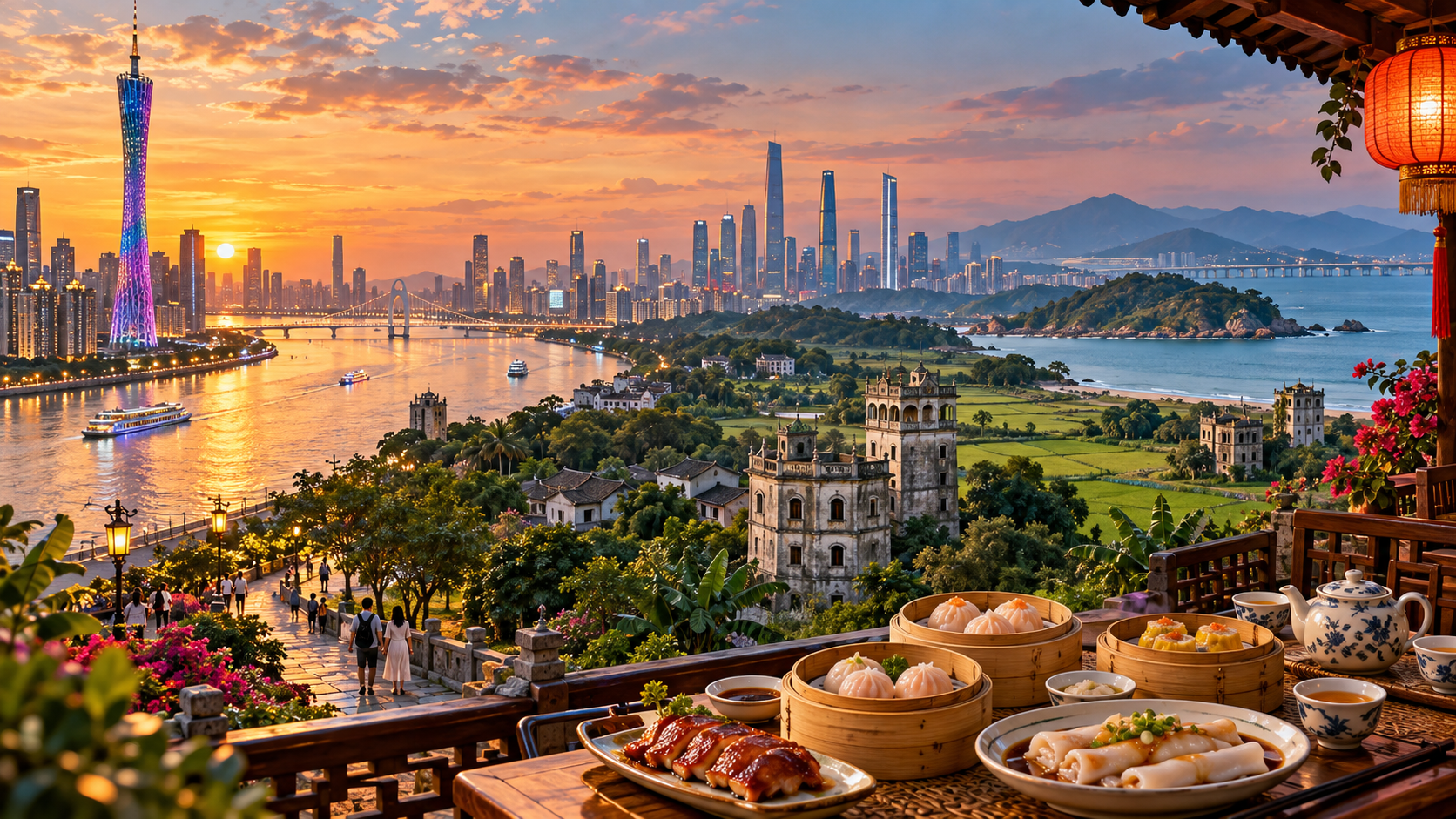
A trip through Guangdong can move from a bamboo steamer in a noisy Guangzhou teahouse to a rooftop view over Shenzhen, then to a fortified village tower surrounded by fields.
That range is what makes the province interesting.
First, where exactly is Guangdong?
Guangdong is in southern China. It borders the South China Sea and surrounds major urban areas linked with the Pearl River Delta and the broader Greater Bay Area.
Guangzhou is the provincial capital. Shenzhen sits to the southeast near Hong Kong. Other major cities include Foshan, Dongguan, Zhuhai, Zhongshan, Jiangmen, Shantou and Chaozhou.
This is not a small destination you can casually “cover” over a weekend.
Guangdong is better treated like a region. Think California rather than one city break. Los Angeles, San Francisco and Yosemite all belong to the same state, but nobody would expect them to feel alike. Guangdong works in a similar way.
| Place | Best Known For | Why It Feels Different |
|---|---|---|
| Guangzhou | Cantonese food, history, Pearl River, urban culture | Traditional neighborhoods sit beside a huge modern skyline |
| Shenzhen | Technology, design, skyscrapers, parks | A young megacity built at remarkable speed |
| Foshan | Martial arts heritage, ceramics, Cantonese traditions | Strong local identity despite being close to Guangzhou |
| Kaiping | Diaolou towers and historic villages | Rural landscapes mixed with Chinese and Western architecture |
| Chaozhou | Teochew food, tea, temples, historic streets | Slower rhythm and a very distinct regional culture |
| Zhuhai | Coastline, islands, relaxed waterfront atmosphere | Feels more open and coastal than the inland megacities |
Distances can look manageable on a map, especially around the Pearl River Delta. But traffic, station transfers and the sheer size of individual cities add time.
So here’s the first useful rule: don’t plan Guangdong as if every city were a neighborhood.
Guangzhou is the natural starting point
If you want to understand Guangdong, Guangzhou makes a lot of sense as your first stop.
The city has been an important commercial center for centuries. Today it is a massive modern metropolis, but older Cantonese culture is still very visible in food, temples, markets, arcaded streets and local routines.
The contrast is immediate.
You may spend the morning walking past low historic buildings and traditional medicine shops, then see the Canton Tower rising above the Pearl River that evening like something from a science-fiction set.
That mix is Guangzhou.
The Canton Tower is hard to ignore
The Canton Tower has become one of the city’s defining landmarks. Its narrow, twisting form stands beside the Pearl River and is especially dramatic after dark.
You do not need to make the tower the center of your entire visit. In fact, the skyline views from across the river can be just as memorable.
Walk the riverfront around sunset and watch the city slowly switch on.
Office towers reflect the last daylight, bridges begin glowing, boats move along the water, and suddenly Guangzhou makes more visual sense.
But the older neighborhoods may stick with you longer
Modern skylines are impressive. They also start looking surprisingly similar after enough travel.
The older parts of Guangzhou are where the city becomes more specific.
Look for traditional arcaded streets, older residential areas, ancestral halls and local markets. Areas around Liwan are often especially rewarding for travelers interested in Cantonese architecture and everyday street life.
And take your time.
One of the easiest mistakes in a city this large is treating old neighborhoods as something to rush through before the next landmark.
Dim sum is not just brunch here
If your experience with dim sum comes from Sunday brunch in San Francisco, New York or Los Angeles, Guangzhou will feel both familiar and completely different.
The Cantonese tradition of yum cha – literally connected with drinking tea – is deeply tied to social life.
People meet over tea. Families gather. Friends talk. Small plates arrive gradually.
It is less “order twelve things as fast as possible” and more a meal that creates its own pace.
Classic dim sum may include steamed shrimp dumplings, pork dumplings, rice noodle rolls, steamed buns, turnip cakes and chicken feet prepared in rich sauces. But the exact menu varies widely by restaurant.
And breakfast can be serious business.
A proper morning tea session may last much longer than the coffee-and-bagel routine many Americans are used to.
Good. Let it.
What should you eat in Guangdong?
Cantonese cuisine is often described as subtle or ingredient-focused, which is true, but it can sound a little boring when phrased that way.
The food is not boring.
The point is that strong seasoning does not have to overpower everything on the plate. Steaming, roasting, braising and quick stir-frying let textures and ingredients matter.
Seafood is especially important in coastal areas, and freshness is taken very seriously.
A few foods worth looking for include:
- dim sum such as har gow, siu mai and rice noodle rolls;
- Cantonese roast meats, including char siu and roast duck or goose;
- wonton noodles in a clear, savory broth;
- fresh seafood prepared simply with ginger, scallions or light sauces;
- congee served plain or with seafood, meat, preserved egg or other toppings;
- double-skin milk and other Cantonese-style desserts;
- regional Teochew dishes if you travel toward eastern Guangdong.
One small warning: American Chinese food names do not always translate neatly into local menus.
Recognizing the English name of a dish does not mean it will arrive in the form you expect.
That’s half the fun.
Shenzhen feels like Guangdong hit fast-forward
Then there is Shenzhen.
If Guangzhou carries layers of visible history, Shenzhen gives you the opposite experience.
The city is strongly associated with modern China’s rapid urban growth, technology, design and business. Tall buildings dominate parts of the skyline, metro stations feel enormous, and entire districts have the polished scale of cities built around very recent growth.
It can feel almost impossibly new.
Yet Shenzhen is not simply a forest of office towers.
There are coastal areas, hiking routes, urban villages, museums, large parks and creative districts. You can spend a morning looking at futuristic architecture and an afternoon walking beside trees and reservoirs.
That contrast is one reason the city is worth more than a quick business-trip stop.
The skyline is part of the experience
Shenzhen’s skyscrapers tell the story even if you know nothing about the city beforehand.
They are huge, close together and often architecturally ambitious.
Night views can be spectacular, particularly around central business districts where towers reflect across plazas and parks.
But try seeing the city at street level too.
Skylines impress you for five minutes. Neighborhood life explains a place.
Kaiping is where Guangdong suddenly looks completely different
Now leave the megacities behind.
Kaiping, in the Jiangmen area, is famous for its diaolou – multi-story fortified towers built in villages and rural landscapes.
The strange part is the architecture.
Some towers combine Chinese building traditions with decorative ideas drawn from Europe and North America. You may see domes, columns and Western-style details sitting above rice fields and traditional village houses.
It sounds like architecture from a dream.
There is a historical reason.
People from the Kaiping region emigrated abroad in large numbers, including to North America, and some later returned with money and architectural influences picked up overseas. The result was a local building style that does not fit neatly into one category.
Kaiping Diaolou and Villages became a UNESCO World Heritage property in 2007.
This is one of the strongest stops in Guangdong for American readers because the history has a direct overseas connection. These buildings physically show how migration changes architecture.
Foshan deserves more attention than it gets
Because Foshan sits close to Guangzhou, travelers sometimes treat it as a suburb and move on.
That is a mistake.
Foshan has its own long cultural history and is closely associated with Cantonese traditions, ceramics and martial arts.
The city is often linked with famous southern Chinese martial arts figures, and visitors interested in kung fu history will find much more context here than in a generic stage show.
Traditional ceramics are another major part of Foshan’s identity.
The interesting thing about visiting places like this is that the experience is less about one giant landmark and more about understanding where everyday cultural traditions came from.
And it makes a useful break from skyscrapers.
Chaozhou introduces another Guangdong entirely
Travel east toward Chaozhou and the food changes. The language changes. Tea culture becomes even more noticeable.
This part of Guangdong is strongly associated with Teochew, or Chaoshan, culture.
For an outsider, it is a good reminder that “Cantonese” and “Guangdong” are not interchangeable words.
The province contains multiple regional identities.
Chaozhou is known for historic architecture, temples, old streets, food and gongfu tea culture. The tea ritual uses small cups and concentrated brews, and the social part matters as much as the drink.
You are not supposed to gulp it like airport coffee.
Slow down.
The food in Chaoshan is worth a separate trip
Food-focused travelers could easily spend days in eastern Guangdong.
Chaoshan cuisine is especially known for seafood, beef hot pot, braised dishes and careful preparation of ingredients.
Beef hot pot may sound straightforward until you see how precisely different cuts are handled.
Thin slices cook quickly in broth, and different textures become part of the experience.
Teochew-style braised goose is another regional specialty, while seafood often appears with very little unnecessary decoration.
When the ingredient is good, the kitchen does not need to shout.
Guangdong has nature too – a lot of it
Urban China gets so much attention that travelers sometimes forget how quickly dense cities can give way to mountains, coastlines and rural landscapes.
Guangdong has all of them.
Its subtropical climate supports lush vegetation across large areas, while the coastline creates beaches, islands and fishing communities.
Mountain landscapes appear farther inland and in northern sections of the province.
So if Guangzhou and Shenzhen start feeling like one giant wall of concrete, you have options.
| Experience | Where to Look | Best For |
|---|---|---|
| Coastal views | Zhuhai, Shenzhen coast, eastern Guangdong | Sea air, waterfront walks, slower days |
| Historic rural scenery | Kaiping and Jiangmen | Villages, architecture, photography |
| Mountain landscapes | Northern Guangdong and inland scenic areas | Hiking and cooler escapes |
| Urban parks | Guangzhou and Shenzhen | Easy breaks without leaving the city |
| Island trips | Coastal Guangdong | Seafood, beaches and short escapes |
You do not need to turn the trip into an expedition.
Even one quieter day between city stops changes the rhythm completely.
Zhuhai is a useful reset button
Zhuhai sits on the coast beside Macao and has a noticeably more relaxed feel than Guangzhou or Shenzhen.
Wide roads, waterfront promenades and sea views give it more breathing room.
That does not mean the city is tiny or sleepy. It simply feels less compressed.
If your Guangdong itinerary includes several major cities, spending a day near the coast can be a smart move.
Walk. Eat seafood. Look at the water.
Not every travel day needs a museum reservation.
What surprises American visitors most?
Probably the scale.
You can read that Guangzhou and Shenzhen are enormous, but numbers remain abstract until a metro ride lasts forty minutes and you are still surrounded by dense city.
The second surprise is how modern the infrastructure can feel.
Urban rail networks, mobile payments, high-speed trains and huge station complexes are normal parts of travel in the region.
Then you leave the station and find a small restaurant where three generations appear to be working behind the counter.
That old-new contrast happens constantly.
Another surprise is food timing.
Morning tea can be a whole event. Lunch may begin earlier than some American travelers expect. Late-night eating is easy in many urban districts.
Your body clock may need a little negotiation.
Getting around is easier than the map suggests
The Pearl River Delta has extensive rail, metro and highway connections.
Guangzhou and Shenzhen both have large metro systems, while intercity trains make travel between major urban centers relatively practical.
But station scale matters.
A “train transfer” may involve a giant complex, security checks, walking and waiting. Give yourself more time than you would for hopping onto a local commuter train back home.
A practical transportation approach looks like this:
- use metro systems inside Guangzhou and Shenzhen for predictable city travel;
- take intercity rail for major city-to-city moves where routes make sense;
- use taxis or ride-hailing for awkward final connections;
- allow extra time at large railway stations;
- group attractions by district rather than crossing a megacity repeatedly in one day.
The last point saves both time and sanity.
Guangzhou may look compact on your phone screen. It isn’t.
When is the best time to visit Guangdong?
Guangdong has a humid subtropical climate across much of the province.
Summers are typically hot, humid and wet. If you visit during that period, expect heat to shape the day.
This is not “walk twenty miles because the sky looks nice” weather for everyone.
Spring can be humid and rainy too, while autumn often brings more comfortable conditions for urban sightseeing.
Winter is mild compared with much of the United States and northern China, making southern China appealing to travelers who prefer cooler but not severe winter weather.
That said, Guangdong is large.
Conditions near the coast are not identical to those in the northern part of the province.
Always check the actual city rather than one generic provincial forecast.
How many days do you need?
If you’re flying across the Pacific, three days is not enough to understand Guangdong.
Five days gives you a basic Guangzhou-plus-Shenzhen introduction.
A week is better.
Ten days starts allowing room for smaller cities, food-focused stops and places like Kaiping or Chaozhou.
For a first trip, you might roughly think in these terms:
- 2-3 days in Guangzhou for food, neighborhoods and major sights;
- 2 days in Shenzhen for modern architecture, parks and city life;
- 1 day or overnight around Kaiping for diaolou villages;
- 1-2 days in Foshan, Zhuhai or another Pearl River Delta city;
- 2-3 extra days if you want to reach Chaozhou or explore eastern Guangdong properly.
Could you see more?
Sure.
But spending every morning checking out of another hotel gets old fast.
Food etiquette is easier than you think
Travelers sometimes get nervous about eating etiquette in China.
You do not need to memorize twenty rules before sitting down.
Watch the table. Follow the general rhythm. Be respectful.
Shared dishes are common, and meals are often social rather than built around one individual plate.
Tea may be poured repeatedly during a meal. At traditional restaurants, staff or other diners might refill your cup before you even notice it is low.
Chopstick etiquette matters, but nobody expects a foreign traveler to behave like they grew up in Guangzhou.
Effort goes a long way.
Guangdong is not one culture with one accent
This point is easy to miss.
Guangdong is often associated internationally with Cantonese culture because Guangzhou and the Pearl River Delta played such a major role in historic overseas migration.
But the province contains several linguistic and cultural traditions.
Cantonese is strongly associated with central parts of Guangdong. Teochew varieties are important in Chaoshan. Hakka communities have their own history, language and architecture in other areas.
Mandarin is widely understood and used, especially in public life and among people who moved to Guangdong from elsewhere in China.
That mix is part of the province’s identity.
One city does not explain the whole place.
Should you combine Guangdong with Hong Kong or Macao?
Geographically, it makes a lot of sense.
Guangdong sits right beside Hong Kong and Macao, and the wider region is increasingly connected by major transport infrastructure.
But remember: border procedures and entry requirements matter because Hong Kong and Macao maintain separate immigration systems from mainland China.
Do not treat the trip like crossing from one U.S. state to another.
Check the rules that apply to your passport and itinerary before travel.
If everything works for your documents, the contrast can be fascinating.
Guangzhou, Shenzhen, Hong Kong and Macao sit close together, yet each feels unmistakably different.
FAQ About Guangdong
Where is Guangdong located?
Guangdong is in southern China along the South China Sea. Guangzhou is its provincial capital, and the province borders Hong Kong and Macao.
What is Guangdong best known for?
Internationally, Guangdong is strongly associated with Cantonese culture and food, Guangzhou, Shenzhen, manufacturing, trade and the Pearl River Delta. It also has historic villages, coastal areas and several distinct regional cultures.
Is Guangzhou the same as Guangdong?
No. Guangzhou is a city and the capital of Guangdong province. Guangdong is the much larger region containing Guangzhou, Shenzhen, Foshan, Zhuhai, Dongguan and many other cities.
What food should I try in Guangdong?
Start with dim sum, Cantonese roast meats, rice noodle rolls, wonton noodles, congee and fresh seafood. If you travel to eastern Guangdong, try Chaoshan beef hot pot and Teochew dishes too.
Is Shenzhen worth visiting for tourists?
Yes, especially if you enjoy modern cities, architecture, technology, design, parks and coastal scenery. Shenzhen offers a very different experience from historic Guangzhou or rural Kaiping.
What are the Kaiping Diaolou?
They are fortified multi-story village towers that combine local Chinese building traditions with architectural influences brought back by overseas emigrants. Kaiping Diaolou and Villages is a UNESCO World Heritage property.
How long should I spend in Guangdong?
Five days works for a quick Guangzhou-and-Shenzhen trip, while seven to ten days allows time for smaller cities, historic villages and regional food. Guangdong is large enough to justify an even longer trip.
Why Guangdong Makes More Sense Once You Stop Treating It as One Destination
The easiest mistake is imagining Guangdong as Guangzhou plus a day trip to Shenzhen.
It is much bigger than that – culturally as well as geographically.
Guangzhou gives you old Cantonese traditions beside a modern megacity. Shenzhen shows what happens when urban growth moves at extraordinary speed. Kaiping tells a story about migration between southern China and places as far away as North America. Chaozhou introduces another food culture, another tea tradition and another rhythm entirely.
Then there are the places in between.
A neighborhood breakfast. A crowded metro platform. A quiet village road. Steam escaping from a bamboo basket. Fresh seafood beside the coast. Someone pouring tea into a cup barely larger than a shot glass.
Those details are where Guangdong starts feeling real.
For American travelers, the province also offers an interesting reversal. Much of what the United States historically came to know as “Chinese food” has deep connections with southern Chinese migration, including people from Guangdong.
Visiting the region puts familiar dishes back into a much larger context.
Suddenly dim sum is not a Sunday novelty. Cantonese barbecue is not just something hanging in the window of a Chinatown restaurant. Tea is not merely the drink that arrives before the meal.
They are pieces of a living regional culture.
And that’s probably the best reason to visit Guangdong.
Come for the big cities if you want. The skylines are impressive.
But stay curious enough to leave them.
The province gets far more interesting once the towers disappear from view.
Leave a Reply