
Say Myanmar and many Americans realize they know surprisingly little about the country. Maybe Bagan comes to mind. Maybe golden pagodas. Maybe a bowl of noodles seen in a travel show years ago. And then… not much.
That is exactly why Myanmar is so interesting to read about.
It sits in Southeast Asia between India, Bangladesh, China, Laos and Thailand, and you can feel that geography in almost everything – the food, the architecture, the spices, the languages and even the way tea is served. Yet Myanmar does not feel like a copy of any of its neighbors. It has its own rhythm.
For a reader in the United States, one of the easiest ways to understand Myanmar is not through a giant history lesson. Start smaller. A breakfast bowl. A cup of tea. A market stall. A temple courtyard. A lake where gardens seem to float on the water.
Those little details tell a much better story.
First, where exactly is Myanmar?
Myanmar is part of mainland Southeast Asia. The country stretches from a mountainous northern region down toward a long coastline on the Bay of Bengal and the Andaman Sea.
That shape matters more than it may seem. Myanmar has highlands, river plains, dry central areas, tropical coastal landscapes and major agricultural regions. In other words, there is no single “Myanmar landscape.” Drive far enough and the scenery changes dramatically.
The Ayeyarwady River, also commonly spelled Irrawaddy in English, is one of the country’s defining geographic features. It runs through much of Myanmar and has shaped settlement, farming, trade and daily life for centuries.
Yangon is the country’s largest city and remains one of the places most outsiders recognize. Mandalay is another famous name, especially for anyone interested in cultural heritage. Then there is Bagan – the vast archaeological landscape that tends to steal the show in travel photography.
| Place | What it is known for | What surprises first-time readers |
|---|---|---|
| Yangon | Urban life, colonial-era architecture, markets and pagodas | How leafy parts of the city can feel |
| Bagan | Historic Buddhist temples and stupas | The sheer scale of the archaeological landscape |
| Mandalay | Crafts, religious sites and cultural traditions | Its strong connection with traditional workshops |
| Inle Lake | Lake communities, gardens and distinctive fishing traditions | How daily life is adapted to the water |
| Central Myanmar | Drier landscapes and historic settlements | How different it looks from tropical coastal Southeast Asia |
And here’s a useful mental shortcut: don’t picture Myanmar as one giant tropical jungle. Parts of the country are lush, yes, but other areas are dry and dusty. Some are mountainous. Others open into broad river plains.
It is a bit like describing the United States with one landscape. Arizona and Vermont are both American, but nobody would confuse them.
Bagan is famous for a reason
You have probably seen the image even if you did not know where it was taken: a wide plain dotted with reddish temples, stupas rising through morning haze, trees scattered between ancient structures.
That’s Bagan.
Located near the Ayeyarwady River, the Bagan cultural landscape contains thousands of recorded historic monuments. Many date to the period between the 11th and 13th centuries, when the area became an extraordinary center of Buddhist architecture and religious life.
What makes Bagan memorable is not one gigantic building. It is the accumulation. Temple after temple. Stupa after stupa. Small structures sitting beside larger ones. Brick, stone, murals, sculptures and archaeological remains spread over a broad landscape.
Think of walking through a place where the historic site is not simply one fenced-off ruin. The landscape itself is the experience.
Bagan was added to the UNESCO World Heritage List in 2019. Myanmar’s other World Heritage property, the Pyu Ancient Cities, joined the list earlier, in 2014.
The Pyu sites are less internationally famous, but their story is fascinating. They include the remains of Halin, Beikthano and Sri Ksetra – ancient walled and moated cities connected with a civilization that flourished for roughly a thousand years, beginning centuries before the Common Era.
For history fans, that’s a reminder that Myanmar’s urban story goes much further back than the destinations typically printed on travel posters.
But the food may be the easiest way in
History is impressive. Lunch is easier.
Myanmar cuisine is especially fun for American readers because some flavors feel familiar at first, then take a sharp turn. You’ll find noodles, rice, broths, herbs, fermented ingredients, fish, crunchy toppings, chilies, garlic and sour notes. But they come together in combinations that have their own character.
One dish often associated with Myanmar is mohinga, a fish-based noodle soup commonly eaten for breakfast. Yes, breakfast.
If your usual morning starts with coffee and toast, a steaming bowl of savory noodle soup at 8 a.m. might sound intense. Give the idea a minute. Plenty of cultures start the morning with something warm, salty and substantial rather than sweet.
Mohinga commonly combines rice noodles with a flavorful fish broth and various seasonings and toppings. Recipes differ, which is part of the point. Home cooking does not behave like a laboratory formula.
Then there is laphet thoke, often translated as tea leaf salad.
And this is where things get interesting.
In the United States, tea is usually a drink. In Myanmar, fermented tea leaves can also become food. A tea leaf salad may combine fermented leaves with crunchy ingredients such as nuts or seeds, legumes, garlic and other seasonings.
The texture is part of the fun – soft, crisp, chewy, salty, tangy. A lot is happening in one plate.
Several foods can give newcomers a useful first glimpse of Myanmar cuisine:
- Mohinga, a savory rice-noodle and fish soup closely associated with breakfast.
- Laphet thoke, a salad built around fermented tea leaves and crunchy toppings.
- Shan-style noodles, linked with the cuisine of Shan State and commonly served in different regional variations.
- Rice dishes accompanied by several small sides, vegetables, relishes or curries.
- Street snacks built around fried dough, noodles, rice or beans – simple food that can be dangerously easy to keep eating.
One warning for readers trying Myanmar food for the first time: the English menu name rarely tells the whole story. “Tea leaf salad” sounds almost delicate. The actual dish can be bold, earthy and surprisingly intense.
And that’s the charm.
Tea in Myanmar is not just tea
Tea culture deserves its own section because a cup of tea can mean more than a drink.
Tea shops have long been social spaces in Myanmar. People sit, talk and eat small dishes while drinking tea. In urban areas, these places can function a little like the neighborhood diner, coffee shop and casual meeting spot rolled into one.
For Americans used to grabbing a latte through a drive-thru window, the difference is easy to picture. One model treats the drink as fuel. The other lets the table become part of the day.
Sweet milk tea is common, and different tea traditions reflect the country’s cultural connections with South and Southeast Asia.
And then, of course, the tea leaves appear on the plate.
This habit of eating fermented tea is one of those cultural details that people remember because it immediately breaks a familiar rule. Leaves go in hot water, right? Well, not necessarily.
Myanmar food reflects its geography
Myanmar shares borders with several major culinary regions, so it would be strange if the food existed in isolation. You can notice connections with Indian, Chinese and Southeast Asian cooking, but local traditions reshape those influences.
Regional variation also matters. Shan cooking is not identical to what you might eat elsewhere. Coastal ingredients are different from ingredients in inland regions. Communities have their own recipes, methods and preferred flavors.
That is why saying “Myanmar food tastes like…” usually ends badly. Like American food, it is too broad a category for one sentence.
| Flavor or ingredient | How it may appear | What an American diner might notice |
|---|---|---|
| Fermented tea leaves | Salads | Earthy, slightly bitter and deeply savory notes |
| Rice noodles | Soups and noodle dishes | Soft texture and a lighter feel than wheat pasta |
| Fish | Broths, sauces and main dishes | Often part of the flavor base rather than only a separate fillet |
| Legumes | Snacks, toppings and side dishes | Extra crunch, body and protein |
| Chili and aromatics | Relishes, sauces and cooked dishes | Heat mixed with garlic, onion and deeper savory flavors |
Another nice detail: texture matters a lot. A dish may combine something soft with something fried, fresh or crunchy. That contrast keeps a simple bowl from feeling boring.
What does everyday clothing look like?
One visual detail visitors often associate with Myanmar is the longyi, a long piece of fabric worn around the lower body. Different styles and patterns are worn by men and women.
From an American perspective, the easiest comparison might be a wrap skirt, but that comparison only gets you part of the way there. The longyi has its own cultural context, styling and practical role in everyday life.
Another recognizable feature is thanaka, a pale cosmetic paste traditionally made from ground bark. It may be applied to the cheeks, forehead or other parts of the face.
People unfamiliar with Myanmar sometimes assume it is simply decorative face paint. Traditionally, however, thanaka has been connected with beauty and skincare as well as daily routine.
You might see it applied in circles, broad patches or more decorative shapes.
And honestly, this is one reason everyday culture is often more interesting than a checklist of monuments. Clothing, breakfast and skincare tell you what people actually do.
The country has more languages than many outsiders expect
Burmese is the official language, and its script is immediately recognizable thanks to its rounded shapes.
But Myanmar is linguistically diverse. Numerous ethnic communities speak their own languages, and multilingual life is normal in many parts of the country.
For English speakers, written Burmese can initially look almost like a continuous collection of loops and circles. It is visually distinctive, and that alone tends to spark curiosity.
English is encountered in some urban, tourism and business settings, but it should never be assumed that everyone speaks it.
A few basic cultural habits also matter more than memorizing ten phrases:
- Show respect around religious sites and follow local rules regarding clothing and footwear.
- Notice what people around you are doing before photographing people or ceremonies.
- Keep your voice and behavior calm in temples and other religious spaces.
- Treat images and statues connected with Buddhism respectfully rather than as funny photo props.
- Remember that customs differ by community and region; one experience does not define the entire country.
Inle Lake looks almost impossible at first
Inle Lake is one of Myanmar’s most recognizable landscapes. Communities around the lake have adapted daily routines to life on and beside the water.
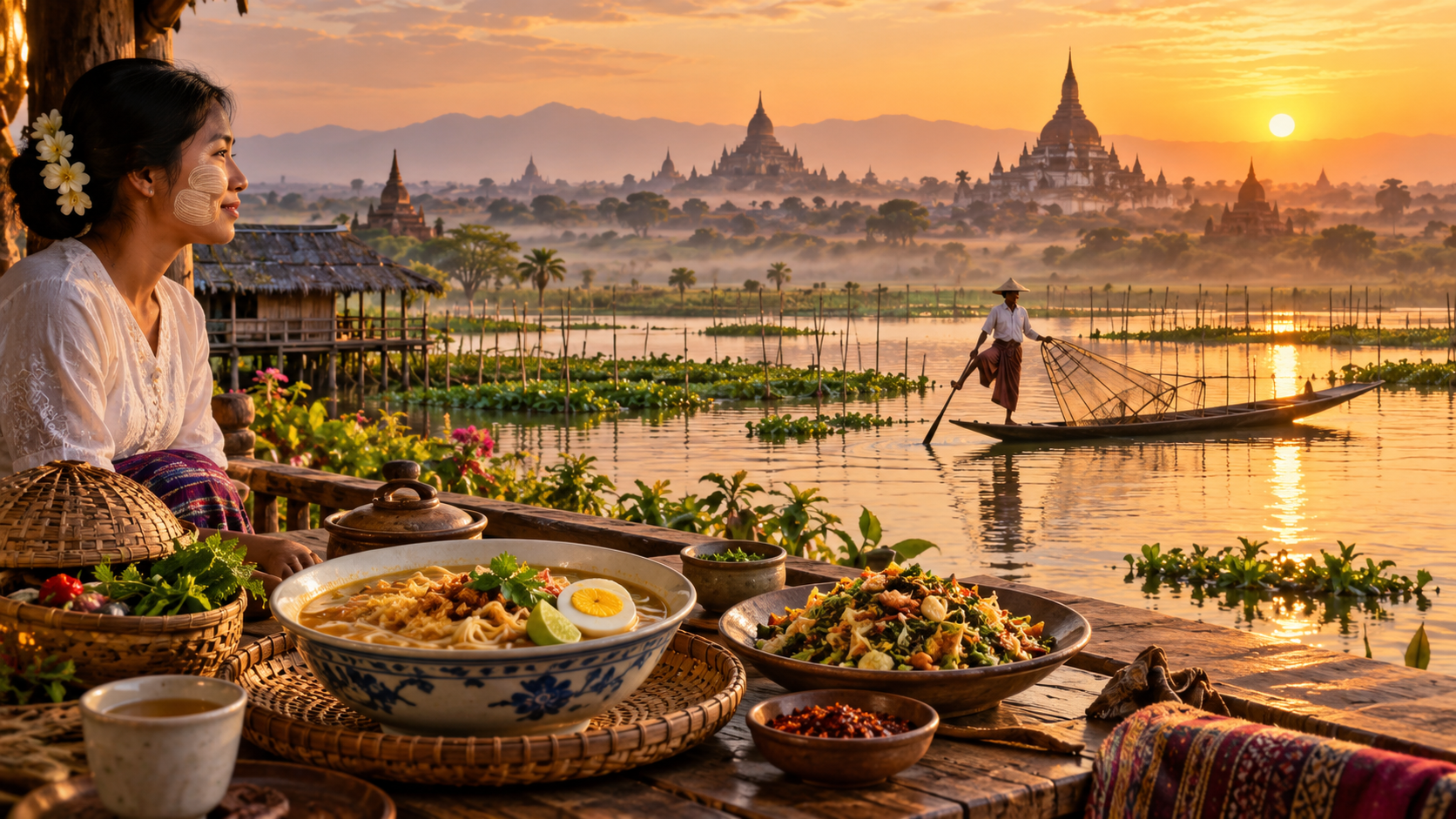
Boats move through channels and open sections of the lake. Houses and structures stand near or above the water. Agriculture has also been adapted to the environment, including the famous floating gardens associated with the area.
Traditional images of Inle often show fishermen using a distinctive leg-rowing technique, balancing while controlling an oar with one leg.
It’s visually striking. But there is a bigger idea behind the famous photograph: people shape everyday technology around geography.
Give humans a lake and generations of experience and they will figure out incredibly specific ways to move, grow food and work there.
That is more interesting than simply calling the place “beautiful.”
Myanmar has a dry side too
Search for Myanmar photos online and tropical green often dominates the screen. Yet central parts of the country can be much drier.
Bagan sits within this central dry zone. The scenery can include dusty ground, scrubby vegetation, palms and a broad sky that makes the brick structures stand out even more.
The contrast with wetter areas is strong.
Myanmar’s climate is influenced by monsoon patterns, so rainfall varies significantly with season and location. Coastal and mountainous regions may receive much more rain than parts of the interior.
For someone accustomed to four classic North American seasons, thinking in terms of wet and dry periods may make more sense than expecting spring, summer, fall and winter to behave the same way they do back home.
Why does Myanmar cuisine feel familiar and unfamiliar at once?
This is probably one of the most interesting questions for an American reader.
You may recognize noodles. Curry-style dishes do not look strange. Fried snacks certainly do not need an introduction. Rice is familiar. Tea is familiar.
Then fermented tea arrives in a salad. Breakfast comes as fish soup. A familiar noodle bowl picks up a flavor you cannot quite place.
The building blocks make sense, but the combination changes the experience.
It is a little like giving five musicians instruments you already know and hearing a completely different song.
That feeling – recognizable but new – makes Myanmar cuisine a particularly easy entry point for anyone curious about the country.
What Americans often get wrong about Myanmar
The most common mistake is probably assuming Myanmar has one culture, one cuisine and one typical landscape.
It does not.
Myanmar has numerous ethnic communities, regional traditions and languages. A dish associated with one area should not automatically be presented as something every family across the country eats in exactly the same way.
The second mistake is reducing Myanmar to temples.
Yes, religious architecture is a major part of the country’s visual identity. Bagan alone makes that obvious. But a country is also markets, apartment buildings, farms, noodle shops, music, school runs, family recipes and people sitting around a table complaining that someone made the tea too sweet.
Normal life matters.
And the third mistake? Expecting everything to fit the general image of “Southeast Asia.”
Regional labels are useful on a map. They become much less useful when they flatten cultures into one big category.
A small Myanmar food night at home
If you live in the United States and your curiosity now involves dinner, you do not need to recreate an entire banquet.
Keep it simple.
- Look for a Myanmar or Burmese restaurant in a city near you and start with two or three shared dishes.
- Try tea leaf salad if available, because it introduces flavors and textures that feel distinctly different from a standard American salad.
- Order a noodle dish alongside it so you can compare something familiar with something less expected.
- If mohinga is offered, consider trying it without worrying that it is “breakfast food.” A good bowl does not care what time your watch says.
- Share several dishes rather than ordering one plate per person. It is a much easier way to explore an unfamiliar cuisine.
Large U.S. cities with diverse Southeast Asian communities may have Burmese restaurants, grocery products or regional ingredients that make this easier.
And if you cannot find a restaurant nearby, even reading a few recipes can teach you something. Ingredient lists reveal cultural connections surprisingly well.
Why Bagan and the Pyu cities matter
Bagan attracts attention because it is spectacular. The Pyu Ancient Cities reward a different kind of curiosity.
The Pyu sites preserve traces of old urban settlements with walls, moats, religious structures and water-management systems. Together they provide evidence of organized urban life stretching back many centuries.
That matters because ancient Southeast Asian history is often barely covered in U.S. schools. Plenty of Americans can name ancient Rome, Athens or Egypt but have never heard of major early urban civilizations in mainland Southeast Asia.
There is a whole historical map most of us were simply never shown.
Myanmar is one good place to start filling in the blank spaces.
Seven common questions about Myanmar
Where is Myanmar located?
Myanmar is in Southeast Asia. It borders Bangladesh, India, China, Laos and Thailand and has coastlines along the Bay of Bengal and Andaman Sea.
Is Burma the same place as Myanmar?
Both names have been used for the country in English. “Myanmar” is the official English-language name used by the United Nations and many international organizations, while “Burma” is still encountered in English in various contexts.
What food is Myanmar famous for?
Mohinga and tea leaf salad are two of the best-known dishes internationally. Myanmar cuisine also includes many noodle, rice, curry, vegetable and regional dishes.
What is Bagan?
Bagan is a major archaeological and cultural landscape in central Myanmar, known for its large concentration of historic Buddhist temples, stupas and related structures.
How many UNESCO World Heritage properties does Myanmar have?
As of 2026, Myanmar has two properties on the UNESCO World Heritage List: the Pyu Ancient Cities and Bagan.
What language is spoken in Myanmar?
Burmese is the official language. Many other languages are also spoken by different ethnic communities across the country.
What is tea leaf salad?
Tea leaf salad, often known as laphet thoke, is made with fermented tea leaves mixed with other ingredients that can include legumes, nuts or seeds, garlic and seasonings. The exact recipe varies.
Myanmar is more interesting when you notice the small things
You could learn about Myanmar by memorizing city names, dates and landmarks. There is nothing wrong with that.
But there is an easier way to make a place stick in your memory.
Remember that tea can be eaten. Remember the morning bowl of mohinga. Picture the brick monuments scattered across Bagan’s dry landscape. Think about communities living around Inle Lake and adapting work to the water. Notice the rounded Burmese script. Picture thanaka on someone’s cheeks and a longyi worn on an ordinary day.
Those details make Myanmar feel less like a distant name on a map.
And they also reveal something bigger. Countries rarely make sense through one famous monument or one “national dish.” They make sense through layers – geography, food, language, habits, history and all the ordinary things people barely think about because they have done them since childhood.
For Americans curious about Southeast Asia, Myanmar is especially interesting precisely because so much of it may feel unfamiliar at first.
Then you notice the universal parts.
People meet over tea. Families have recipes they argue about. Cities grow around rivers. Communities adapt to heat, rain, mountains and water. Old buildings survive beside everyday life. Breakfast has its own rules.
Different details, familiar human logic.
And that may be the best starting point for understanding Myanmar.
Leave a Reply