
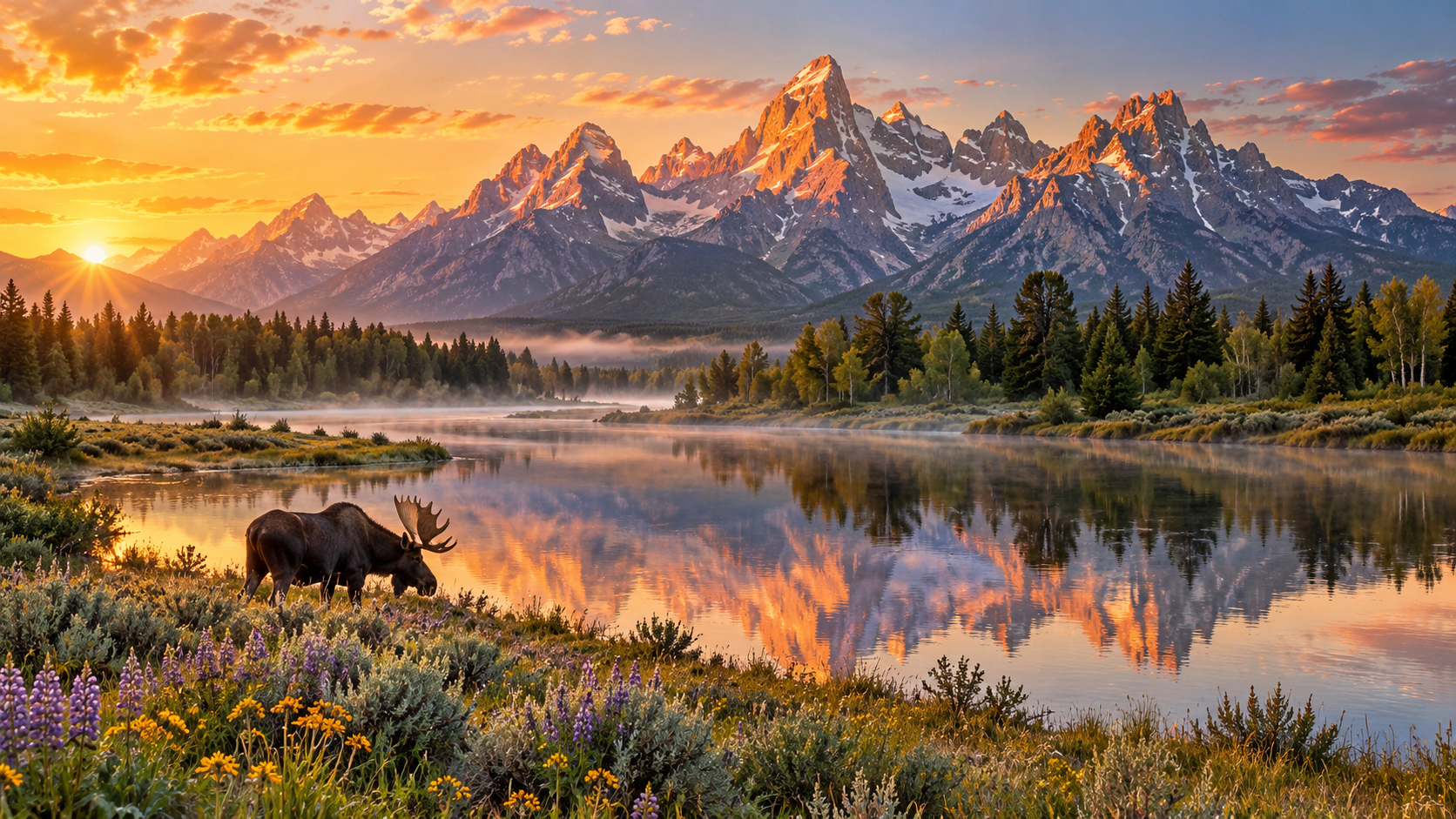
Some mountains look impressive in photos. The Grand Tetons are different. Photos almost undersell them.
You drive through the wide Wyoming valley, glance toward the horizon, and suddenly there they are – sharp granite peaks rising almost straight out of the flat land. There is very little visual warning. No long staircase of smaller foothills blocking the view. Just mountains. Big ones.
That dramatic first look is one reason the Grand Tetons have become such a classic American road-trip destination.
But Grand Teton National Park is not only about standing beside the road and taking mountain photos. There are glacial lakes, easy walks, serious backcountry trails, wildlife, historic ranch buildings, scenic drives, boating, fishing, cycling, and some genuinely excellent places to sit down and do absolutely nothing for twenty minutes.
Honestly, that last activity may be underrated.
If you are planning your first trip to the Grand Tetons, here is what actually matters: where to go, what season feels right, how much time you need, and which famous stops deserve the hype.
First things first: where are the Grand Tetons?
The Teton Range sits in northwestern Wyoming, close to the Idaho border. Grand Teton National Park protects much of the mountain range and the valley immediately east of it.
The town of Jackson lies south of the park and is the main gateway for many visitors. Yellowstone National Park is directly north, which is why the two parks are often paired on one road trip.
That combination sounds obvious on a map. In practice, though, rushing through Grand Teton simply because Yellowstone is next door is a mistake.
The park deserves its own time.
Grand Teton itself rises to 13,775 feet, but you do not need to climb anything remotely that high to appreciate the landscape. Some of the most memorable views are available from roads, lakeshores and relatively short trails.
That makes the park unusual. It can feel wild and dramatic without demanding that every visitor be an experienced mountaineer.
Why do the Tetons look so dramatic?
Here is the cool part.
Many mountain ranges rise gradually. You see foothills first, then higher ridges, then eventually the tallest peaks.
The Tetons do not really play by that visual rule.
The eastern side of the range rises sharply above Jackson Hole, the broad valley below it. Because there are no major foothills hiding the mountains from this side, the elevation change looks almost absurdly sudden.
That is why photos from places like Mormon Row, Snake River Overlook and the Jackson Lake area have such a strong visual punch. You get open foreground, then mountain wall.
Simple formula. Incredible result.
And yes, photographers have been obsessed with it for generations.
How many days do you really need?
You can drive through Grand Teton National Park in one day. Technically.
But that is a little like going to New York, seeing Times Square from a taxi and saying you’ve done Manhattan.
For most first-time visitors, two or three full days works much better. It gives you enough time to enjoy the famous places without spending the entire trip checking the clock.
| Trip Length | What You Can Realistically Do | Best For |
|---|---|---|
| 1 day | Scenic drive, major viewpoints, Jenny Lake, a short walk | Road trips with limited time |
| 2 days | Scenic highlights plus one good hike and wildlife viewing | Most first-time visitors |
| 3 days | Several hikes, lakes, sunrise or sunset, slower exploring | A balanced first trip |
| 4-5 days | Longer hikes, boating, photography, quiet areas and repeat visits | Outdoor lovers |
If you are combining the Grand Tetons with Yellowstone, three nights near Grand Teton is a comfortable amount for many travelers.
Could you stay longer? Easily.
The funny thing about mountain trips is that a schedule that looks generous at home starts feeling weirdly short once you’re there.
Jenny Lake deserves the attention
Jenny Lake is one of those places that appears on almost every Grand Teton itinerary, which naturally makes some travelers suspicious. Is it actually special, or just famous because everybody keeps repeating the same recommendations?
In this case, it earns the attention.
The lake sits directly beneath the Teton Range. The water, forest and steep peaks create the sort of landscape people picture when they imagine a trip to Wyoming.
You can walk near the lake, hike around sections of the shoreline, paddle, or take the seasonal shuttle boat across the water when it is operating.
The boat is useful because it provides easier access to the area around Hidden Falls and Inspiration Point. For visitors who want mountain scenery without committing to a huge backcountry day, that combination is hard to beat.
But there is a catch: Jenny Lake gets busy.
During the popular summer season, arriving early is not just travel-blog advice people repeat because it sounds responsible. Parking really can become difficult at major locations.
Morning also has another advantage – cooler temperatures and calmer light.
The scenic stops that are actually worth stopping for
The Grand Tetons reward people who pull over a lot.
Not randomly, obviously. Use designated turnouts. But do not treat the park roads as something you simply need to get through.
Some of the best experiences require almost no hiking at all.
- Snake River Overlook gives you a classic view of the river corridor with the Teton Range behind it.
- Oxbow Bend is a favorite area for landscape photography and wildlife watching, especially when the water is calm.
- Mormon Row combines historic buildings, open fields and one of the most recognizable mountain backdrops in Wyoming.
- Jackson Lake offers broad water-and-mountain views that feel completely different from the tighter scenery around Jenny Lake.
- Schwabacher Landing is popular for reflections and quiet views along the Snake River area.
Here’s the trick: don’t try to photograph every turnout.
Pick a few. Get out of the car. Walk around. Look at the mountains without immediately holding a phone in front of your face.
Sounds obvious. Somehow it isn’t.
Mormon Row is more than an Instagram stop
You have probably seen the photo.
An old wooden barn sits in a wide field while the Tetons rise behind it. Maybe the morning sun hits the peaks. Maybe there is frost on the grass. The whole thing looks suspiciously perfect.
Those historic structures are part of the Mormon Row Historic District, where homesteaders established farms in the late 1800s and early 1900s.
The barns have become famous photo subjects, but knowing even a little of the history changes the experience.
This was not built as a scenic attraction. Families lived and worked here in a landscape that could be beautiful one day and brutally demanding the next.
Wyoming winters do not care about your mountain-view real estate.
Visit early in the morning and the area can be particularly striking. You may also see wildlife in the surrounding valley, though sightings are never guaranteed.
Wildlife is part of the trip, but keep your distance
Grand Teton National Park is home to large animals that most Americans rarely encounter in everyday life.
Moose, elk, bison, pronghorn, black bears and grizzly bears all live in the broader ecosystem. Wolves may also be seen, though they are much harder to spot.
Seeing one can turn a completely normal drive into the story everyone tells at dinner.
But there is a strange thing that happens in national parks. People who would never approach a random 1,000-pound animal at home suddenly see a bison and think, “I should stand closer.”
Nope.
Park rules require visitors to remain at least 100 yards from bears and wolves and 25 yards from other wildlife. More distance is fine. In fact, more distance is often better.
And if an animal changes its behavior because of your presence, that is a pretty strong clue that you are too close.
Bear country changes how you hike
This part matters.
The Grand Tetons are bear country. Both black bears and grizzly bears live in and around the park.
That does not mean you should be scared to hike. Thousands of people hike here. It does mean you should act like you are visiting wildlife habitat rather than an outdoor theme park.
- Carry bear spray where it can be reached quickly, not buried under three sweaters inside your backpack.
- Stay alert, especially in dense vegetation or places where visibility is limited.
- Make your presence known rather than trying to move silently through bear habitat.
- Store food and scented items properly.
- Never approach a bear for a better photo.
There is a weird temptation to think that safety advice is mainly for inexperienced tourists.
It isn’t. Experienced hikers follow it too. That’s partly why they become experienced hikers.
Which hikes work for a first visit?
Grand Teton has more than 250 miles of trails, so there is no single “best hike.” What works depends on fitness, weather, snow conditions and how much of your vacation you want to spend climbing uphill.
Some visitors want an easy lakeside walk. Others look at a mountain and immediately wonder how far they can get before lunch.
Both approaches are valid.
| Area or Hike | General Feel | Good Choice If You Want… |
|---|---|---|
| Jenny Lake area | Popular, scenic, flexible | Classic views and several route options |
| Hidden Falls | Moderate outing depending on route | A waterfall and forest scenery |
| Inspiration Point | Steeper than a casual lakeside walk | Elevated views above Jenny Lake |
| Taggart Lake area | Mountain and lake scenery | A half-day style hike |
| String Lake area | Gentler terrain near water | A relaxed outing or family walk |
| Backcountry canyon routes | Longer and more demanding | A serious hiking day |
Trail conditions can change quickly because of snow, storms, wildlife activity, maintenance and seasonal closures. A route that sounds easy on paper may feel completely different at elevation during bad weather.
So build a little flexibility into the day.
The mountains will not be offended if you change plans.
When is the best time to visit the Grand Tetons?
This question sounds simple, but there is no perfect month for everyone.
Grand Teton National Park is open year-round. However, many visitor facilities, campgrounds and roads operate seasonally, and May through September is the busiest general travel period.
Summer gives you the broadest access.
June, July and August are popular for hiking, boating, camping and family road trips. Days can be pleasant, but mountain weather still changes fast. Afternoon storms can happen. Cool mornings are normal.
September is a favorite for many repeat visitors because temperatures begin to cool, summer crowds may ease, and fall color starts appearing in parts of the valley.
October can feel far quieter and much more unpredictable. Snow becomes increasingly possible, nights get cold, and seasonal services begin shutting down.
Winter creates an entirely different park. Snow covers much of the landscape, and activities shift toward cross-country skiing and snowshoeing.
Spring is beautiful but messy. Snowmelt, muddy trails and changing access are simply part of the deal.
What should you pack?
Wyoming weather has a sense of humor.
You can leave your hotel under clear blue skies and find yourself reaching for a jacket later the same day. Elevation and mountains create conditions that can shift much faster than many visitors expect.
Layers are the easy answer.
- Bring a warm layer even when the daytime forecast looks comfortable.
- Pack rain protection rather than trusting a sunny morning.
- Wear shoes appropriate for the trail you actually plan to hike.
- Carry water and snacks, especially once you leave developed areas.
- Bring sunscreen and sunglasses; mountain sun can feel stronger than expected.
And yes, binoculars are genuinely useful here.
They let you watch wildlife from a responsible distance instead of slowly becoming the person everyone else at the turnout is nervous about.
Sunrise or sunset?
If you can manage an early alarm, sunrise has a strong argument.
The mountains sit west of much of the valley, so morning light can illuminate the range beautifully. Mormon Row, Schwabacher Landing and several eastern viewpoints are popular around sunrise for exactly that reason.
Early morning can also bring calmer water, fewer vehicles and better chances of seeing active wildlife.
But let’s be realistic. Not everybody wants to wake up at 4:45 a.m. on vacation.
Sunset is lovely too. The mountains may become darker silhouettes while the sky changes behind or around them, depending on your location and season.
The real answer? Try one early morning during your trip.
You can complain about the alarm later.
Do you need to stay in Jackson?
No, but Jackson is convenient.
The town sits south of Grand Teton National Park and offers hotels, restaurants, stores and the kind of vacation infrastructure that makes life easier after a full day outside.
It also has a lively Western-tourism feel. Some people love it. Others would rather wake up closer to the mountains.
Inside and around the park, seasonal lodging and camping options can put you much closer to places like Jenny Lake, Jackson Lake and Colter Bay.
Where you stay changes the rhythm of the trip.
Stay near Jackson and you get more dining and town options. Stay farther north and you can reduce driving for certain park areas. Camp and your experience becomes something else entirely.
None is automatically better.
Grand Teton and Yellowstone: should you visit both?
Yes, if you have enough time.
No, if combining them means racing through both.
Yellowstone and Grand Teton sit next to each other, but they do not feel interchangeable.
Yellowstone is famous for geothermal features, huge wildlife habitat, waterfalls and an enormous road network. Grand Teton feels more visually concentrated around the mountain range, lakes and valley.
A common mistake is giving Yellowstone four or five days and the Grand Tetons half a day because Grand Teton looks smaller on the map.
Smaller does not mean skippable.
If you have a week for the region, splitting your time between the two parks makes sense. If you have only two days total, trying to “finish” both may create more windshield time than actual enjoyment.
Driving is easy, but distances sneak up on you
Grand Teton is very road-trip friendly. Major scenic areas connect through paved roads, and there are plenty of legitimate viewpoints and turnouts.
Still, do not judge the day by mileage alone.
Twenty miles can take much longer than expected when you stop three times for mountain views, get caught behind traffic, wait for wildlife near a road, and suddenly decide you absolutely need another photo of Jackson Lake.
Also watch carefully around dawn and dusk. Wildlife may be near or on roads.
The goal is not to cover the maximum number of miles.
The goal is to see the place.
The best Grand Teton trip is not necessarily the busiest one
This may be the most useful advice in the whole article.
Leave empty space in your itinerary.
National parks encourage checklist behavior. Jenny Lake. Check. Mormon Row. Check. Moose. Check. Photo. Next stop.
But the moments people remember are often unplanned.
Maybe clouds clear while you are eating lunch beside a lake. Maybe a moose appears far across a wet meadow. Maybe you stop at a turnout because the light suddenly looks ridiculous.
If every hour has a reservation attached to it, you lose room for that stuff.
The Grand Tetons are especially good at rewarding people who slow down.
FAQ About the Grand Tetons
How many days should I spend in the Grand Tetons?
Two or three full days is a good starting point for first-time visitors. Three days gives you enough time for scenic drives, Jenny Lake, wildlife viewing and at least one solid hike without rushing.
What is the best month to visit Grand Teton National Park?
July and August usually offer broad access to roads, trails and visitor services, while September can bring cooler temperatures and fall color. The ideal month depends on whether you care most about hiking, crowds, snow or scenery.
Can you see the Grand Tetons without hiking?
Absolutely. Many outstanding mountain views are visible from scenic roads, turnouts, Mormon Row, Jackson Lake and other accessible areas. Hiking adds another layer, but it is not required for a memorable visit.
Are there bears in Grand Teton National Park?
Yes. Both grizzly bears and black bears live in the park. Visitors should follow bear-safety guidance, carry bear spray when appropriate and remain at least 100 yards away from bears.
Is Jenny Lake worth visiting?
Yes. Jenny Lake combines easy access, mountain scenery, hiking, boating and connections to places such as Hidden Falls and Inspiration Point. It is popular for good reason, though arriving early can make the experience easier.
Can I visit Yellowstone and the Grand Tetons on the same trip?
Yes. The parks are neighbors and are commonly combined. Give each one enough time, though. Trying to see both in a single rushed day usually means spending too much of the trip in the car.
Do I need a 4WD vehicle for Grand Teton National Park?
Not for most standard sightseeing. Major park roads and popular visitor areas are accessible by regular passenger vehicles when roads are open and conditions are normal. Always check seasonal and weather-related road conditions before traveling.
Why the Grand Tetons stay with you
There are bigger national parks. There are taller mountains in the United States. There are places with stranger geology and places with more famous hiking trails.
But the Grand Tetons have one unfair advantage: everything comes together in a remarkably compact landscape.
A lake can sit below a granite mountain wall. A historic barn can frame the same peaks from miles away. A moose may appear in a wet meadow while morning light hits the range behind it.
And even after you have seen the mountains fifty times during the trip, you still look up when they appear again.
That’s probably the best sign that a place is doing something right.
So don’t treat the Grand Tetons as the quick stop before Yellowstone. Give yourself a few mornings. Take a trail that fits your ability. Sit beside Jenny Lake. Drive slowly through the valley. Keep your distance from wildlife. Stop when the light looks good.
And every once in a while, put the camera away.
The mountains are already doing enough.
Leave a Reply