
Type “sao paulo” into a search bar and the first impression can be a little confusing.
There are skyscrapers. Traffic. Rooftops stretching toward the horizon. Street art. Japanese lanterns. Modern museums. Old markets. Tiny coffee counters wedged between huge buildings. And enough restaurants to make dinner decisions feel like a minor life crisis.
São Paulo is not the Brazil of beach postcards.
There is no famous strip of white sand running beside downtown. No giant mountain rising behind the skyline. The city gets its power from something else: scale, movement, food, immigration, art, work, neighborhoods and the feeling that something is always happening three blocks away.
For American travelers, the easiest comparison might be New York, Los Angeles and Chicago thrown into a blender – except that comparison still misses most of the point.
São Paulo feels Brazilian in its own very specific way.
It is huge, messy, creative, hungry, stylish, tiring and strangely addictive. One neighborhood can feel polished and businesslike. Ten minutes later you are eating Japanese pastries under red street lamps. Later that evening, you might end up at a tiny bar where everyone seems to know exactly what to order except you.
That’s part of the fun.
So, how big is São Paulo really?
Big enough that you should stop thinking about it as one compact tourist center.
São Paulo is the largest city in Brazil and the core of one of the world’s major metropolitan areas. But numbers don’t really explain what that means on the ground.
Here’s a better picture.
You can spend an entire afternoon exploring Avenida Paulista and nearby streets without touching the historic center. You can dedicate another day to Liberdade, another to Pinheiros and Vila Madalena, and still feel like you have barely scratched the surface.
That is normal.
Trying to “finish São Paulo” in two days is like trying to finish Los Angeles before lunch. You can see highlights. You cannot absorb the whole thing.
| Area | What It Feels Like | Why Go |
|---|---|---|
| Avenida Paulista | Busy, cultural, modern | Museums, architecture, people-watching, easy first-day exploring |
| Liberdade | Dense, colorful, food-focused | Japanese and broader Asian-Brazilian culture, markets and snacks |
| Vila Madalena | Creative, casual, social | Street art, cafés, bars and evening energy |
| Pinheiros | Urban, food-driven, local | Restaurants, coffee shops, bars and independent stores |
| Historic Center | Layered, intense, architectural | Older buildings, churches, cultural sites and city history |
| Ibirapuera Area | Greener, slower, open | Walking, cycling, museums and a break from concrete |
And this leads to the first useful rule: plan São Paulo by neighborhood, not by individual attraction.
Crossing the city repeatedly because one restaurant looked good on Instagram is a quick way to spend your vacation staring through a windshield.
Avenida Paulista is the easiest place to understand the city
If you have one morning and no idea where to begin, Paulista makes sense.
Avenida Paulista is one of São Paulo’s most recognizable streets. Office towers stand beside cultural institutions, shopping centers, restaurants, apartment buildings and pockets of greenery.
It can feel corporate during the workweek and completely different when pedestrians take over parts of the avenue during the city’s open-street program.
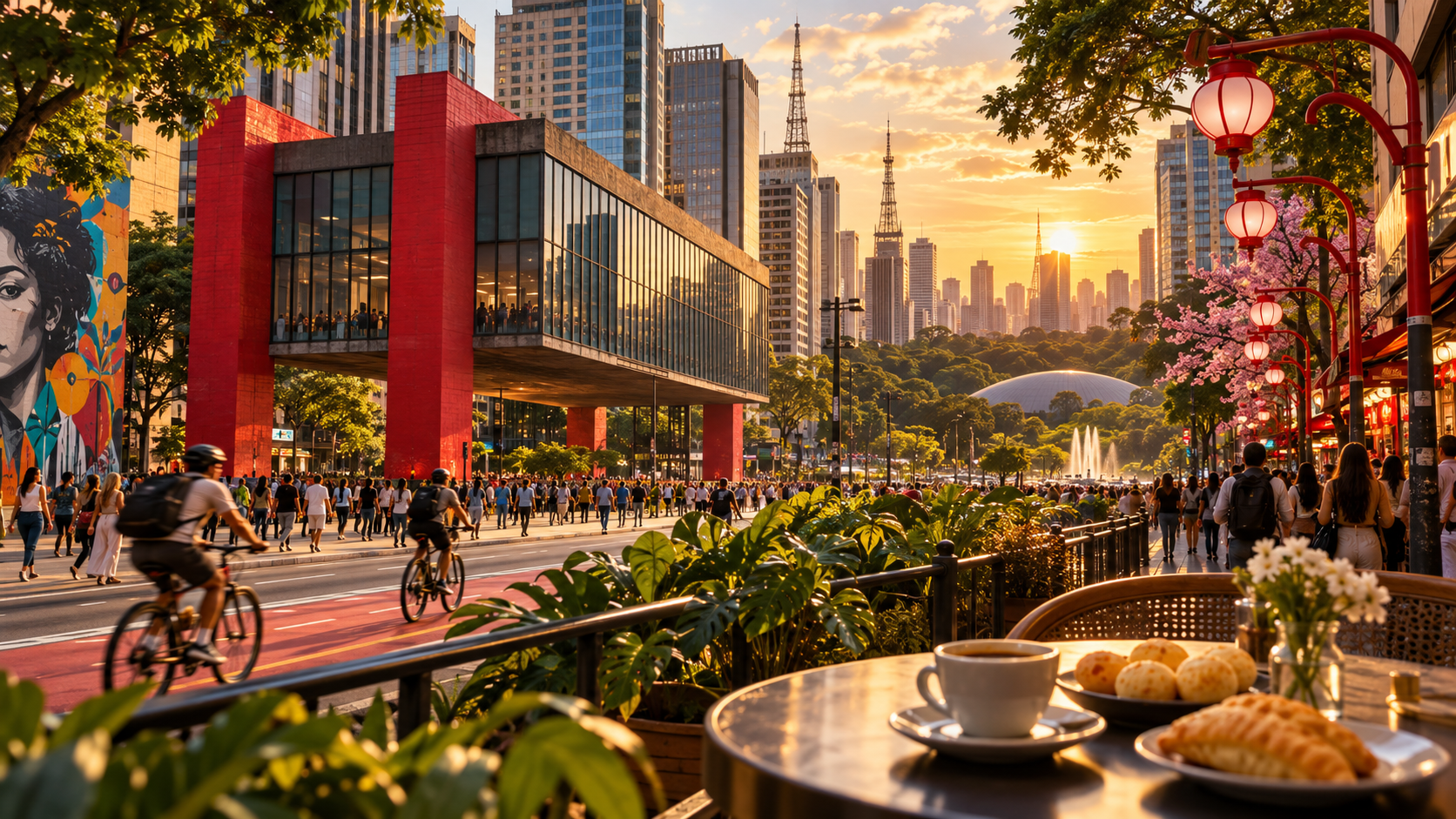
On Sundays, the atmosphere can become much more casual. People walk, cycle, listen to street musicians and simply hang out in a place that normally carries heavy urban traffic.
This is one of the best ways to understand São Paulo’s personality.
The city is intense, yes. But Paulistanos are very good at finding ways to occupy public space and make a giant metropolis feel oddly social.
MASP – the São Paulo Museum of Art – sits directly on Paulista and is hard to miss. Its main building appears suspended above an open plaza, supported by a striking structural frame.
Even travelers who normally say “I’m not really a museum person” may want to stop.
The building itself is part of the experience.
And then there’s Liberdade
Walk through parts of Liberdade and the visual mood changes fast.
Red lantern-style streetlights, Asian grocery stores, bakeries, restaurants, beauty stores, markets and food counters create one of São Paulo’s most recognizable neighborhood identities.
Liberdade is widely associated with the city’s Japanese-Brazilian community, which has deep roots here. Over time, the neighborhood has also become home to businesses and residents connected with other Asian communities, including Chinese and Korean culture.
That mix matters.
Calling Liberdade simply “São Paulo’s Japantown” makes the story too neat.
The neighborhood’s history stretches further back and includes earlier Black and Indigenous presence as well as later waves of migration. Today, it is a busy commercial and cultural district with layers that are easy to miss if you only stop for ramen and a photo under the lanterns.
Still, stopping for food is a perfectly good start.
You may find:
- Japanese bakeries selling sweet and savory pastries;
- ramen, udon, sushi and casual rice dishes;
- Korean restaurants and specialty grocery products;
- Asian sweets, teas and packaged snacks that are harder to find elsewhere;
- small stores packed with kitchenware, cosmetics and imported foods.
Weekends can get crowded. Very crowded.
If you prefer actually looking at things instead of slowly shuffling behind twenty people, a weekday visit is calmer.
São Paulo takes food almost personally
This may be the fastest way to fall for the city.
São Paulo eats well.
And not in one neat “Brazilian cuisine” category.
Its restaurant scene reflects generations of immigration from Italy, Japan, Portugal, the Middle East and many other regions, plus food traditions from across Brazil itself.
You can eat a classic Brazilian lunch one day, Lebanese food the next, excellent pizza that evening and Japanese food after midnight if your schedule gets weird enough.
No one will think this is unusual.
Pizza deserves special mention because Paulistanos have strong opinions about it. São Paulo has a huge pizza culture shaped in part by Italian immigration, and many local pizzerias treat the meal as a proper evening event rather than fast food.
Then there is the mortadella sandwich associated with the city’s famous Mercado Municipal.
It is enormous.
This is not delicate lunch food. It is the kind of sandwich that arrives and makes you reconsider whether breakfast was necessary.
What should a first-time visitor actually eat?
You could spend a week organizing your trip entirely around restaurants. Honestly, people do.
But for a first visit, it helps to mix classic São Paulo habits with broader Brazilian staples.
- Try pão de queijo, small cheese breads that work dangerously well with coffee.
- Order a proper Brazilian plate with rice, beans, meat and sides at a casual lunch spot.
- Have pizza one evening and notice how seriously the city takes it.
- Try pastel, a thin fried pastry that can come with savory or sweet fillings.
- Drink fresh sugarcane juice if you see it being served alongside pastel.
- Give brigadeiro a chance even if you normally don’t care about candy.
And coffee?
Yes. Absolutely.
Brazil is one of the world’s great coffee-producing countries, but don’t assume every cup in São Paulo arrives from a minimalist specialty café with a tasting card.
Traditional Brazilian coffee culture often means small, strong, straightforward cups consumed quickly.
Modern specialty shops now sit alongside that older habit.
Both are worth trying.
Ibirapuera is where São Paulo catches its breath
After a couple of days surrounded by buildings, traffic and restaurant reservations, green space starts looking very attractive.
Enter Ibirapuera Park.
It is one of São Paulo’s best-known public parks and functions as a major recreational and cultural space. People run, walk, cycle, picnic, meet friends and simply lie on the grass pretending they are not in one of the biggest cities in the Americas.
The park also has strong links with Brazilian modernist architecture and major cultural institutions.
You do not need an agenda.
In fact, this may be one of those places where having no agenda works better.
Walk. Sit. Buy something cold to drink. Watch runners who appear much more motivated than you feel.
Every huge city needs an escape valve. Ibirapuera is one of São Paulo’s.
Street art here is not a side note
São Paulo has a powerful relationship with street art.
The most famous first stop for visitors is probably Beco do Batman, or Batman Alley, in Vila Madalena.
The name makes it sound like a Batman-themed tourist attraction.
It isn’t.
The area is known for walls covered in murals and graffiti, with artworks changing over time. It has become heavily visited, so do not expect some secret underground alley that only local artists know about.
Still, it’s visually fun and makes sense as part of a broader walk through Vila Madalena.
The trick is not to visit only the alley.
Walk the surrounding streets. Stop for coffee. Look at independent shops. Continue toward Pinheiros if you have the energy.
That turns one photo stop into an actual afternoon.
Pinheiros may be where you start wishing you lived here
Some places impress you with monuments.
Pinheiros often works through normal life.
Coffee shops. Restaurants. Small bars. Stores. People walking dogs. Tables spilling onto sidewalks. Friends meeting after work.
The neighborhood has become one of São Paulo’s popular food and nightlife areas, and it is a useful place for visitors who want a less monument-focused afternoon.
You can start with coffee and accidentally still be there six hours later.
No grand plan required.
And that highlights something important about São Paulo: some of the city’s best experiences are not “sights.”
They’re neighborhoods.
São Paulo is a city of immigration
This is one of the biggest keys to understanding the food, architecture and culture.
Immigration reshaped São Paulo dramatically in the late 19th and 20th centuries, bringing communities from Italy, Japan, Portugal, Spain, the Middle East and many other regions.
Later migration within Brazil also transformed the city, with millions of people arriving from other parts of the country.
The result is not some perfect multicultural postcard where every tradition remains frozen in place.
Real cities don’t work like that.
Cuisines change. Languages mix. Families marry across backgrounds. Neighborhoods shift. Recipes adapt because someone’s grandmother couldn’t find the exact ingredient she used back home.
And eventually that modified recipe becomes the tradition.
That is São Paulo in miniature.
What does a normal day in São Paulo cost?
This varies a lot, especially because Americans usually feel exchange-rate changes immediately.
But the main point is simple: São Paulo can be either relatively affordable or surprisingly expensive depending on how you travel.
| Travel Style | Typical Choices | What Changes the Cost Fast |
|---|---|---|
| Budget | Metro, casual lunches, bakeries, free parks | Staying in a central, well-connected area |
| Mid-range | Comfortable hotel, restaurants, rideshares, museums | Frequent cross-city rides and cocktails |
| Food-focused | Simple breakfast, destination restaurants at night | Tasting menus and wine |
| Luxury | Upscale hotels, private transportation, fine dining | High-end restaurants and nightlife |
One useful trick is to spend money selectively.
Have a simple breakfast at a neighborhood bakery, take the metro to Paulista, eat a casual lunch and save your budget for a great dinner.
São Paulo rewards that approach because excellent food exists at almost every price level.
The metro is more useful than many first-time visitors expect
São Paulo’s size makes transportation intimidating at first.
Then you look at the rail map and things start making more sense.
The metro and connected urban rail system cover many areas visitors commonly use. Paulista, Liberdade, the historic center, Pinheiros and several major cultural areas can be reached or approached by rail.
That doesn’t mean the train goes to every door.
São Paulo is still huge, and rideshare apps are often useful for the final stretch or for trips between areas with awkward transit connections.
A practical approach is usually a mix:
- use the metro for predictable cross-city trips;
- walk within compact neighborhoods during the day;
- use a rideshare when the route becomes inconvenient or late-night travel feels easier that way;
- avoid planning multiple attractions on opposite sides of the city in one afternoon;
- leave extra travel time because a short distance on a map does not always mean a short trip.
And yes, rush hour is real.
If you have no need to join millions of commuters at the busiest moment of the day, don’t.
What about safety?
This is one of the first questions Americans ask, and pretending it doesn’t matter would be silly.
São Paulo is a major city. Conditions differ enormously by neighborhood, block and time of day.
The sensible approach looks much like urban travel elsewhere: know where you’re going, avoid flashing expensive gear unnecessarily, pay attention when using your phone in public and ask local hotel staff about areas you plan to visit at night.
Do not turn awareness into paranoia.
Millions of people live ordinary lives here every day. They go to work, meet friends, walk dogs, buy groceries and complain about traffic.
But also don’t treat a city of this scale like a resort complex where every street serves tourists.
Street-by-street awareness matters.
The historic center is worth seeing – with some planning
São Paulo’s center contains some of the city’s most important architecture and cultural history.
You’ll find large plazas, old churches, landmark buildings and streets that show different eras of São Paulo layered almost on top of each other.
The Catedral da Sé is one of the major visual landmarks.
Nearby areas connect with the historic core of the city, while places such as the Municipal Theatre add another architectural layer.
The center can also feel much more intense than Paulista or Ibirapuera.
This is where planning helps.
A guided walk can make the district easier to understand because individual buildings suddenly stop looking like random architecture and begin forming an actual city story.
What Americans usually misunderstand about São Paulo
The first mistake is expecting Rio.
São Paulo is not Rio without a beach.
The cities have different identities, landscapes and rhythms. Comparing everything to Rio is a bit like visiting Chicago and spending the whole weekend asking why it isn’t Los Angeles.
The second mistake is looking for one postcard attraction.
São Paulo doesn’t really work that way.
The city becomes interesting through accumulation: coffee in one neighborhood, a museum in another, lunch somewhere else, an evening bar, street art, architecture, traffic, conversations, food.
The third mistake is staying only around the hotel.
São Paulo’s personality changes dramatically between neighborhoods.
You need some movement.
Not fifty Uber rides a day. Just enough to see the contrasts.
When should you visit São Paulo?
Unlike destinations built around a beach season or ski season, São Paulo works as a year-round city trip.
Its subtropical climate means you should expect seasonal changes without assuming they match what Americans call winter and summer back home.
Brazilian summer runs roughly from December through March. Days can be warm, humid and rainy, with summer storms sometimes arriving hard and fast.
Winter, roughly June through August, is generally cooler and can feel pleasant for long urban walks.
Spring and fall sit somewhere in between, though São Paulo weather has never signed a contract promising perfect predictability.
Pack for changes.
An umbrella is not a ridiculous idea.
Three days or five?
Three days works if you mainly want an introduction.
You could spend one day around Paulista and Ibirapuera, one exploring Liberdade and the center, then a third around Pinheiros and Vila Madalena.
Five days feels more relaxed.
It allows time for museums, longer meals, markets and the underrated pleasure of returning to a neighborhood because you liked it instead of constantly chasing the next attraction.
If food is a major reason you’re coming, add time.
Lunch has a habit of becoming dinner planning.
FAQ About São Paulo
Is São Paulo worth visiting for tourists?
Yes, especially if you enjoy food, museums, architecture, neighborhoods, nightlife and big-city culture. It is less about famous natural scenery and more about urban experiences.
How many days do you need in São Paulo?
Three days is enough for a solid introduction. Four or five days gives you much more breathing room and lets you explore neighborhoods instead of rushing between landmarks.
Does São Paulo have beaches?
No. São Paulo city is inland. The state of São Paulo has a long Atlantic coastline, but reaching the beach requires leaving the city.
Is São Paulo walkable?
Individual neighborhoods can be very walkable, but the entire city is far too large to explore on foot. Metro, trains, buses and rideshare services are useful for moving between areas.
What food is São Paulo known for?
Pizza has a major place in local food culture, while pastel, mortadella sandwiches, Brazilian lunch plates, Japanese-Brazilian cuisine, bakery snacks and specialty coffee are also easy to find.
What is the best neighborhood for a first-time visitor?
Areas near Avenida Paulista are convenient because they offer good transport connections, cultural attractions, restaurants and relatively easy access to several other parts of the city.
Is São Paulo the capital of Brazil?
No. Brasília is the capital of Brazil. São Paulo is the country’s largest city and a major center for business, culture, food and entertainment.
Why São Paulo Starts Making Sense After a Few Days
São Paulo rarely wins people over in the first five minutes.
That’s almost part of its charm.
You arrive, see towers, traffic and a city that appears to have forgotten where its edge is. Then things begin to click.
You find a bakery you like.
You realize the metro is easier than expected.
You spend an afternoon on Paulista. You eat something in Liberdade you’ve never tried before. You sit in Ibirapuera while cyclists fly past. You notice murals on a street you had no reason to photograph five minutes earlier.
And somewhere between lunch and a late coffee, the city stops feeling like one enormous concrete block.
It becomes a collection of smaller worlds.
That is the trick with São Paulo.
Don’t come looking for one perfect viewpoint that explains everything. It doesn’t exist.
Come for the layers.
The Italian influence beside Japanese-Brazilian culture. A modern museum beside heavy traffic. A tiny coffee counter under a thirty-story building. Sunday pedestrians filling a street built for cars. A neighborhood bar that feels more memorable than the attraction you carefully scheduled that morning.
São Paulo is not tidy tourism.
It is a city you figure out while you’re already inside it.
And once you stop expecting it to behave like a postcard, that’s when it gets good.
Leave a Reply