
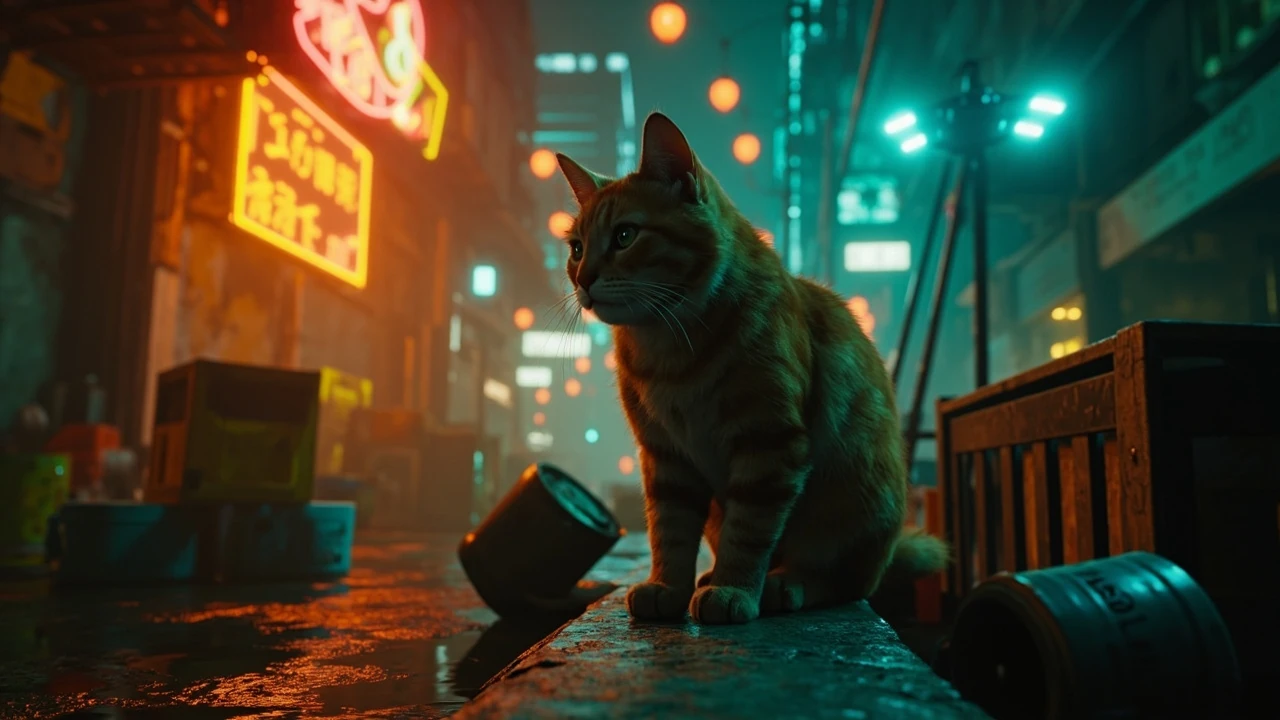

Stray walkthrough: chapter routes, collectibles, and tips
Stray is short on dialogue and long on atmosphere, which is exactly why a route guide is more useful here than in a typical action game. The player reads the environment, solves light puzzles, and keeps a cat alive through a vertical city built for robots, and the order of operations is not always obvious from the camera alone. This stray walkthrough collects the chapter-by-chapter route, the collectible locations, the puzzle logic, and the small frustrations that send players searching online, so you can move through the story without breaking the pacing the designers built into the world.
The route below assumes a first play on Normal difficulty. If you are replaying for collectibles or trophies, jump to the section that matches your current chapter. Where a puzzle has more than one valid path, the guide describes the path that uses the smallest number of optional detours, and then lists the alternative in a short note so the choice is yours. If you would rather learn the design language behind the game instead of a route, the closing section covers level design, camera framing, and the way Stray handles collectibles as world-building rather than as checklist filler.
How this guide is organized
Each chapter section follows the same template: a one-line goal, the route in plain language, the puzzle solutions in order, and the collectibles with their location notes. The collectible lists describe what is on screen, not what is on a HUD, because the game’s diegetic notebook is the only reliable tracker. If you want to use this guide alongside a second screen, the route is short enough to read in advance and long enough that a spoiler-free run still benefits from a checklist of memory locations. Two summary tables sit further down the page: one for collectibles by chapter, and one for puzzle solutions in the order they appear. Use them as a quick reference after you have read the chapter sections.
Tips that apply to every chapter
These habits save real time across the whole game, not just the chapter where you first learn them, and they come up again in the route descriptions below.
- Look up, then look down. Stray’s ledges are almost always signaled by lighting and texture, but the camera frames them at unusual heights. Tilt the stick up to inspect beams and signs before you commit to a jump, and tilt down to confirm there is a safe surface under the cat before letting go of a ledge.
- The drone backpack is the only HUD element that matters. The drone’s flashlight is the contrast tool, the bucket is the interaction tool, and the translator is the narrative tool. When you are stuck, ask which of those three is missing from the puzzle. Most stalls come from forgetting the flashlight or trying to solve a sensor room without the bucket in hand.
- The bucket is indestructible but the cat can only carry one object at a time. Dropping the bucket on a hazard will break the run, and there is no way to recall it from a distance. Drop the object near where you need it, not on top of a hazard, and never store a paint can on a moving platform.
- Save by leaving an area. Stray uses a soft checkpoint through chapter transitions and major story triggers. There is no manual save menu, so backing out from a long puzzle room returns you to the last stable point. The game also saves at the start of every named puzzle, which makes it safe to experiment with order in the sewer pump room.
- The game does not punish death, but it punishes impatience. A fall to a lower level is fine, a fall into a void resets you. When a route looks too convenient, it usually is, and the intended path involves a wall run or a small detour around a piece of signage.
- Read the notebooks, not just the posters. The diegetic notebook is the only place the game tracks collectibles, and it is also where the translator drops lore hints that unlock optional dialogue in the Slums and Midtown. Skipping a notebook page can lock you out of a small but readable side story about the robots.
- Camera framing beats minimap every time. Stray does not expose a minimap, and the third-person camera is the only spatial aid. When the next platform is not visible, the path is almost always up rather than forward, and the lighting on the wall will usually mark the route before the geometry does.
Chapter 1: Outside the Wall
The opening chapter is a tutorial disguised as a survival sequence. You control the cat from a top-down third-person view, the camera is far enough back to read the environment, and the verbs that the rest of the game relies on have not been introduced yet. The chapter is short, but it establishes the camera language Stray will use for the next eight chapters: the camera frames the next platform above the cat, so when the next platform is not visible, the path is usually up rather than forward.
Work your way down the flooded tunnel by jumping between rusted barrels, then up the broken ramp on the right side. The first collectible notebook sits on a low pipe to the left of the ramp, partially hidden by a hanging tarp. After the cutscene where the cat falls into the robot city, the second collectible is on a metal shelf behind the first vendor you meet, near a stack of blue barrels. If the cutscene triggers before you grab the first notebook, backtrack through the tunnel and the item is still there, because the chapter does not despawn collectibles on story triggers.
The puzzle of the chapter is the bucket tutorial. Pick up a paint can from the floor, carry it to the window, drop it on the ledge below the target window, and let the bucket land on the can to reach the higher floor. If the can rolls, pick it up and try a flatter surface. The intended order is paint can, then bucket, but the game accepts any object heavy enough to climb on, including a stack of books on a lower shelf. The chapter ends with a cutscene that introduces the drone backpack and the first real robot vendor.
Chapter 2: The Village
The Village chapter is the social heart of the game, and the place where the collectible density spikes. There is no combat and no fail state beyond falling, so the only reason to read a walkthrough here is to keep track of where the memory tokens sit. The chapter’s spatial layout is a ring of plazas connected by alleys, and the camera frames each plaza as a separate readable space, which means the player can almost always tell which direction the next vendor is in by where the camera tilts.
From the entrance, the first plaza has a memory token on a rooftop accessible by jumping from the awning of the bar. The second is in the back room of Morusque’s house, behind the sheet music stand. The third sits on a low wall near the market vendor. The fourth is on a crate behind the shrine, reached by jumping from the back of a parked van. If you are playing for the trophy tied to finding all four, the order above matches the order the camera frames them, which is also the order the notebook lists them after the chapter transition.
The chapter’s only puzzle is the rooftop chase that introduces the Zurks. Run in a straight line along the catwalk, do not try to turn around, and let the camera frame the next safe platform. Jumping sideways to grab a token during the chase is a soft fail, because the Zurks will catch the cat before the animation finishes. If you want a token that is on the chase route, skip it the first time and pick it up in chapter replay after the credits roll.
Chapter 3: Midtown
Midtown is the chapter where Stray shifts from exploration to navigation. The player has access to the backpack drone, the flashlight, and the bucket, and the puzzles assume you will combine them. The level is laid out as a vertical stack of three districts, and the route is a slow zig-zag from the bottom district to the upper platform where the sewer entrance sits. The lighting is darker than the Village, which is why the flashlight becomes mandatory rather than optional in the upper two districts.
The chapter opens with a vendor who sells food for the cat and a robot who asks for a code. The code is on a poster in the alley behind the noodle shop, four digits on a torn page. The mid-district has a memory token on a balcony reached by a wall run from the laundromat roof. The upper district is a series of puzzle rooms that require the bucket, a light source, and a place to put both. The intended solution is always the same: place the bucket so the cat can climb, place the light so the drone can reach the sensor, and never stack the two on the same platform.
Midtown has three memory tokens, two of which are in the puzzle rooms and one of which is on a balcony accessed by a wall run. If you miss the wall run, the camera will not reframe the balcony, because the geometry is set up so the cat has to leap off a sign at a specific angle. The intended jump is from the second billboard on the left side of the laundromat roof, not from the first, and the wall run starts on a painted stripe that is hard to see in dim lighting.
Chapter 4: The Slums
The Slums chapter is the most navigation-heavy section of the game, and the place where players most often get stuck. The level is a series of stacked rooftops connected by zip lines, ladders, and broken signage, and the camera does not always frame the next platform. The route is best described as a clockwise spiral from the entrance to the pipe maze, with two off-shoots for the supermarket puzzle and the apartment block collectible run.
The first puzzle in the Slums is the supermarket, where the cat has to reach a high shelf. The solution is to push a stack of cans to the wall, climb the cans, jump to the shelf, and walk across the top of the shelving unit to reach the back office. The office has a memory token on the desk, and a notebook entry that introduces the trader robot. From the supermarket, the route goes up two ladders, across a zip line, and into the apartment block where the chapter’s main collectible run begins.
The Slums have five memory tokens and two badges. The badges sit in a hidden alley accessed by jumping from a fire escape onto a billboard, and on a balcony reached by a wall run from the laundry room. The memory tokens are scattered across the rooftops, and the only reliable way to find them is to follow the catwalks to their dead ends, because the camera frames the tokens as small colored lights against the dark sky. Two of the five are easy to miss: one is on a crate behind a stack of paint cans on the lower rooftop, and one is on a fire escape behind the noodle shop, only visible after a wall run from a sign that the camera does not highlight.
Chapter 5: Rooftops
Rooftops is the shortest chapter in the game, and the only one with no collectibles. The chapter is a single long chase sequence, followed by a short stealth section, followed by a cutscene. The chase sequence is timed by the camera, not by the player, so the only reliable strategy is to stay ahead of the camera frame and let the next safe platform appear in the center of the screen. Trying to outrun the chase by going sideways will reset the cat to the last safe point, and there is no penalty for retrying other than a short animation.
The stealth section introduces the flash mechanic, and the only way to fail it is to walk through a flashlight beam. The intended route is a clockwise path through the storage yard, with the cat hiding behind crates and the drone’s flashlight turned off. The chapter ends with a cutscene that introduces the next act, and a chapter transition that the game treats as a hard save. If you are playing on Hard mode, the stealth section adds an extra patrol path that is not present on Normal, and the timing window for each hiding spot shrinks by about a second.
Chapter 6: The Sewers
The Sewers chapter is the most linear section of the game, and the one with the highest concentration of platforming puzzles. The level is laid out as a single pipe with branches, and the branches are dead ends unless you have the right equipment. The route is to follow the main pipe to the first junction, take the right branch to the pump room, solve the pump puzzle, and return to the main pipe for the rest of the chapter. The water level rises slowly during the chapter, but it never reaches the cat’s platform, so there is no timing pressure beyond the camera framing.
The pump puzzle is the chapter’s main test, and it is the one place where a walkthrough is genuinely necessary. The puzzle has three valves, each on a different level, and each valve controls a different drain. The solution is to open the left valve first, the right valve second, and the center valve last. The puzzle resets if you open the center valve first, so the order matters. The chapter’s memory token is on a pipe behind the pump room, reached by jumping from the valve platform, and the only way to reach the pipe is to climb the right valve after the puzzle is solved.
Chapter 7: Dead End
Dead End is the chapter where Stray stops being a walking simulator and starts being a survival game. The chapter is set in a factory, the enemies are Zurks, and the only verb is run. The level is a series of conveyor belts and crushing machines, and the camera frames the next safe platform as a brightly lit area at the edge of the frame. The lighting in the factory is harsh and warm, which is a deliberate contrast to the cool neon of the Slums and the soft amber of the Village.
The chapter’s main puzzle is the crane room, where the cat has to reach a series of high platforms while the crane moves overhead. The solution is to wait for the crane to swing left, run to the next platform, and wait for the crane to swing right. The pattern repeats three times, and the camera frames the crane as a shadow on the wall, not as a moving object in the foreground. The chapter’s memory token is on a balcony reached by a wall run from the crane room’s exit, and the wall run is only available after the crane has swung right for the final time.
Chapter 8: The City
The City is the final open chapter, and the place where the game trades puzzle density for atmosphere. The level is a vertical slice of the robot city, with the cat moving from the lower platform to the upper platform where the final door sits. The route is a slow climb through residential blocks, and the only puzzle is the door code at the end. The camera frames the city as a series of stacked silhouettes, which is also where the soundtrack shifts to the slow, piano-led theme that plays over the credits.
The door code is in a notebook in the library, on a shelf above the librarian’s desk. The code is four digits, and the digits are the same as the chapter number, so the puzzle is more about finding the notebook than about solving the code. The chapter has three memory tokens, all on rooftops, and the only reliable way to find them is to follow the catwalks to their dead ends. Two of the three are framed as small lights against the sky, and one is on a balcony reached by a wall run from a sign near the residential block.
Chapter 9: The Control Room
The Control Room is the final chapter, and the only one with a fixed ending. The level is a single room, the puzzle is a series of switches, and the only verb is interact. The solution is to pull the switches in the order the camera frames them, which is the order they appear in the room. The chapter has no collectibles, and the only way to fail it is to skip the cutscene that triggers the ending. The control room is the only place in the game where the cat’s shadow is rendered on the floor in real time, which is a small but readable cue that the final sequence has begun.
Collectible checklist by chapter
The table below lists every collectible in the game, the chapter where it appears, and the type of collectible. Use it as a checklist if you are replaying for trophies or achievements. The “location note” column describes the collectible in terms of the environment, not the HUD, because the game’s diegetic notebook is the only reliable tracker.
| Chapter | Collectible type | Count | Location note |
|---|---|---|---|
| Outside the Wall | Memory | 2 | One on a low pipe near the ramp, one on a metal shelf behind the first vendor. |
| The Village | Memory | 4 | Rooftop above the bar, back room of Morusque’s house, low wall near the market vendor, crate behind the shrine. |
| Midtown | Memory | 3 | Balcony reached by wall run from the laundromat roof, behind the noodle shop, on a crate in the upper district. |
| The Slums | Memory and Badge | 5 and 2 | Five on rooftops along the catwalks, two on a hidden alley and a balcony reached by wall run. |
| Rooftops | None | 0 | Chase and stealth chapter, no collectibles. |
| The Sewers | Memory | 1 | On a pipe behind the pump room, reached by jumping from the valve platform. |
| Dead End | Memory | 1 | On a balcony reached by wall run from the crane room’s exit. |
| The City | Memory | 3 | All on rooftops, follow the catwalks to their dead ends. |
| The Control Room | None | 0 | Final chapter, no collectibles. |
Puzzle solutions in order
The puzzles in Stray are short, but the order of operations is not always obvious from the camera. The table below lists every named puzzle in the game, the chapter where it appears, and the intended solution. Use it as a reference if you are stuck on a specific room and do not want to read the chapter section above. Where a puzzle has an alternative, the alternative is listed in the chapter section rather than the table, because the table is meant to be a quick lookup.
| Chapter | Puzzle name | Intended solution |
|---|---|---|
| Outside the Wall | Bucket tutorial | Pick up a paint can, drop it on the ledge, drop the bucket on the can, climb up. |
| The Village | Zurks chase | Run forward, do not turn around, let the camera frame the next platform. |
| Midtown | Code entry | Read the poster in the alley behind the noodle shop, enter the four-digit code. |
| Midtown | Sensor room | Place the bucket so the cat can climb, place the light so the drone can reach the sensor. |
| The Slums | Supermarket shelf | Push cans to the wall, climb up, walk across the top of the shelving unit. |
| The Sewers | Pump room | Open the left valve, then the right, then the center. |
| Dead End | Crane room | Wait for the crane to swing left, run forward, wait for it to swing right. |
| The City | Final door | Read the notebook in the library, enter the four-digit code that matches the chapter number. |
| The Control Room | Switch sequence | Pull the switches in the order the camera frames them. |
Design notes: how Stray handles space and collectibles
Stray is a small game, and the design is more legible than its length suggests. The level design uses a vertical stack of readable spaces, the camera frames the next platform above the cat, and the collectibles are framed as small colored lights against the sky. The diegetic notebook is the only HUD element, and the bucket is the only verb the cat can extend through the drone. The result is a game that asks the player to read the environment rather than the interface, and the walkthrough above is a backup for the moments when the camera is not generous enough to do that work alone.
For broader context on the game’s release, the studio history, and the way the cat was integrated into a third-person adventure template, the Wikipedia entry for the game collects the production credits, the platform list, and the awards in one place. For a critical take on how the design choices play in practice, the Verge review from 2022 is the most cited English-language review of the game and is a useful counterweight to a route guide, because it focuses on feel rather than order of operations.
Frequently asked questions
How long is a full run of Stray?
A first run on Normal difficulty takes most players between five and seven hours, depending on how much time is spent exploring the Slums and Midtown. A collectible run adds another two to three hours, and a speedrun of the main story is just over an hour. The chapter structure is fixed, so the variance comes from exploration, not from branching paths.
Does Stray have difficulty settings?
Stray does not expose a difficulty menu in the traditional sense, but the game has a Normal mode and a Hard mode that affects puzzle hints and enemy density. Hard mode is unlocked after the first playthrough and does not change the route, only the amount of guidance the game provides. The camera framing and the level layout are identical on both modes, which means the walkthrough above still applies on Hard.
Where are all the memory tokens in The Slums?
The Slums have five memory tokens. One is on a balcony reached by a wall run from the laundry room, one is on a catwalk above the market, one is on a rooftop reached by a zip line, one is on a fire escape behind the noodle shop, and one is on a crate near the exit. The tokens are framed as small colored lights, so the easiest way to find them is to follow the catwalks to their dead ends and look up. Two of the five are easy to miss on a first run because the camera does not highlight their ledges.
What is the code for the Midtown door?
The code is on a poster in the alley behind the noodle shop, four digits on a torn page. The code is not randomized, so the same four digits work for every player. The puzzle is more about finding the poster than about solving the code, because the alley is easy to miss on a first run and the poster is partially covered by a stack of crates.
How do I get past the crane room in Dead End?
The crane room is a timing puzzle, not a platforming puzzle. The solution is to wait for the crane to swing left, run to the next platform, and wait for the crane to swing right. The pattern repeats three times, and the camera frames the crane as a shadow on the wall. If you are being hit by the crane, you are not waiting long enough for the swing to complete, and the cat will be knocked back to the previous platform without a fail state.
Can I replay chapters to find missed collectibles?
Stray does not have a chapter select, but the game does have a chapter replay mode that is unlocked after the first playthrough. The replay mode lets you select any chapter from the main menu, and the collectible state is preserved between runs. If you miss a memory token in The Slums, you do not need to replay the whole game to find it, and the replay mode keeps the notebook state from the original save.
Does Stray have trophies or achievements?
Stray has a trophy set on PlayStation and an achievement set on Steam and other PC storefronts. The set includes story trophies, collectible trophies, and a small number of interaction trophies. The collectible trophies are the ones that require a replay, because the game does not give a collectible counter in the HUD. The interaction trophies are tied to small actions like knocking objects off shelves, which the camera does not always highlight.
Is there a way to see the collectible count in Stray?
Stray does not expose a collectible counter in the HUD, but the diegetic notebook updates when you pick up a memory token. The notebook is the only reliable tracker, so the easiest way to confirm a collectible is to check the notebook after picking it up. The chapter transition also triggers a chapter summary that lists the collectibles found in that chapter, and the summary is the closest thing the game has to a checklist screen.
What is the difference between the PS4, PS5, and PC versions?
The PS4 version runs at 1080p with a 30 fps target, the PS5 version runs at 4K with a 60 fps target, and the PC version is uncapped with a recommended spec of an RTX 2070 and a Ryzen 5 3600. The route and the puzzles are identical across versions, and the only difference is the frame rate and the resolution. The PC version supports ultrawide monitors, but the camera framing is not optimized for aspect ratios above 21:9, which can clip the edges of the sensor rooms in Midtown.
Is Stray available on Mac or Linux?
Stray is available on macOS through the Mac App Store and on Steam for macOS. The Linux version is not officially supported, but the game runs through Proton on most modern distributions. The route and the puzzles are identical across platforms, and the only difference is the frame rate and the input method. On Mac, the recommended spec is an M1 chip or later, and older Intel Macs may need lower graphics settings to hold a stable frame rate in the factory chapter.
What is the cat’s name in Stray?
The cat is never named in the game, and the credits do not assign a name to the cat. The cat is referred to as “the cat” in the script, and the collectible entries refer to the cat as “you.” The lack of a name is a deliberate design choice, because the game is a walking simulator and the camera is the only consistent identifier. The credits do list the motion capture performer, who was filmed with a real orange tabby as a reference for the animation team.
How do the Zurks work in Stray?
The Zurks are swarming enemies that appear in two chapters, and they are the only enemy type in the game. The Zurks do not have a health bar, and the only way to avoid them is to run. The camera frames the Zurks as a moving mass at the bottom of the screen, so the safest path is to stay above them. The Zurks cannot climb, so any platform above their reach is safe, which is why the chase sequence in the Village is solved by going up rather than sideways.
What is the final puzzle in Stray?
The final puzzle is the door code in The City chapter. The code is in a notebook in the library, on a shelf above the librarian’s desk. The code is four digits, and the digits are the same as the chapter number, so the puzzle is more about finding the notebook than about solving the code. The Control Room chapter has a switch sequence, but the switches are pulled in the order the camera frames them, so the puzzle is more about attention than about logic.
Does Stray have a New Game Plus mode?
Stray does not have a traditional New Game Plus mode, but the chapter replay mode is unlocked after the first playthrough. The replay mode lets you select any chapter from the main menu, and the collectible state is preserved between runs. The replay mode does not change the route, only the collectible tracking, and the Hard mode toggle is available from the same menu.
How does the drone backpack work in Stray?
The drone backpack is the cat’s only companion, and it serves three functions: it carries the bucket, it carries the flashlight, and it carries the translator. The drone is controlled with a separate button, and the camera frames the drone as a small light in the corner of the screen. The drone is the only HUD element that matters, and the puzzles assume you will use the drone to extend the cat’s reach into sensor rooms that the cat cannot enter directly.
Can you pet other cats in Stray?
Stray does not have a petting mechanic, and the cat is the only cat in the game. The lack of other cats is a deliberate design choice, because the game is a walking simulator and the camera is the only consistent identifier. The collectible entries refer to the cat as “you,” and the script refers to the cat as “the cat.” There are robot vendors who comment on the cat, but none of them are scripted to react to being petted, because the cat cannot reach most of them with the bucket in hand.
What is the best way to play Stray for the first time?
The best way to play Stray for the first time is to read the environment, not the walkthrough. The game is short enough that a first run on Normal difficulty takes most players between five and seven hours, and the puzzles are designed to be solved by observation. The walkthrough is a backup, not a replacement, and the route above is the path that uses the smallest number of optional detours. If you want the trophies on a first run, replay the Slums and Midtown in chapter replay after the credits, because the collectible state is preserved and the route is identical.
Are there any missable moments in the story?
There are no branching endings, but there are small optional moments that lock out if you skip a chapter too quickly. The most common missable is the conversation with the librarian in The City, which only triggers if you sit on the desk for a few seconds before reading the notebook. The conversation does not affect the ending, but it is the only place the librarian mentions the cat by name, and it is the closest the game comes to a named protagonist. Other missables include a poster in the Slums that references the studio’s previous game, and a small animation in the credits that only plays if every memory token is collected.
Leave a Reply